I was looking through the texts and research of the late Lester Bridaham at work, which he gathered for his famous book, Gargoyles, Chimeres, and the Grotesque in French Gothic Sculpture (reprinted by Dover Architecture as The Gargoyle Book: 572 Examples of Gothic Architecture). Bridaham had conducted extensive research on European Gothic architecture and mythological creatures, including basilisks, unicorns, and mermaids. On a small index card, he had written the name Oannes, which struck me immediately for many purposes. Firstly, I had not heard of such a myth before and I was tempted to learn more. Second, Oannes sounds just like Hovaness (Armenian for John), which is a common Armenian name. Until now, I assumed Hovaness is a Biblical name (John the Baptist). However, I had never known the history of the name goes back much further. And finally, Mr. Bridaham conducted research on Oannes because he was a merman; does this mean that Oaness may have been the first Merman in the history of mythology (at least that’s what Bridaham believes!)?
![oannes[3]](https://theuntitledartblog.com/wp-content/uploads/2014/05/oannes3.gif?w=300&h=187)
Oannes depicted in an Egyptian style headdress
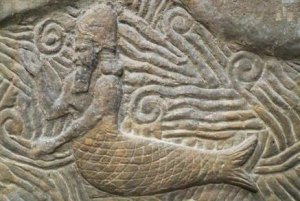
Oannes Relief
Ancient gods, no matter how ridiculous and unusual they may be to us, do not die out with the kingdom they belong to. [And I’m not just talking about ancient god/alien conspiracies!] Links between ancient religious deities are always present. For instance, Varuna, the water god of Vedism and in Hindu mythology, is almost identical to Oannes. Many times, Oannes was also depicted wearing an Egyptian style headdress in the form of a fish, rather than being half-human, half-fish.

Varuna
The story of Oannes may even be where the story of John the Baptist originated from. John the Baptist is mentioned in many Western religious texted and is most widely known for his practice of Baptism to wash away all sins. Most visual depictions of John the Baptist show him near a body of water. Thus, there can only be a conclusion that there is a clear connection between the ancient Babylonian god of water and knowledge and John the Baptist.
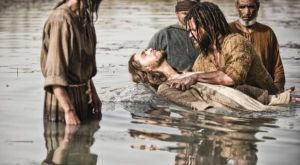
John the Baptist and Jesus
For instance, in this painting by Nicolas Poussin, a French baroque painter, Saint John the Baptist is baptizing citizens. Because people were illiterate, the best way to show Biblical stories was through imagery. In the center is Saint John. Even if the viewer was not familiar with religious figures, Poussin has positioned the bodies and gazes of surrounding figures towards St. John. Furthermore, just in case the viewer was wondering what in the world is Saint John’s story, Poussin had placed him near a body of water to make the relation clear. Therefore, St. John the Baptist is the Biblical reincarnation of Oannes.
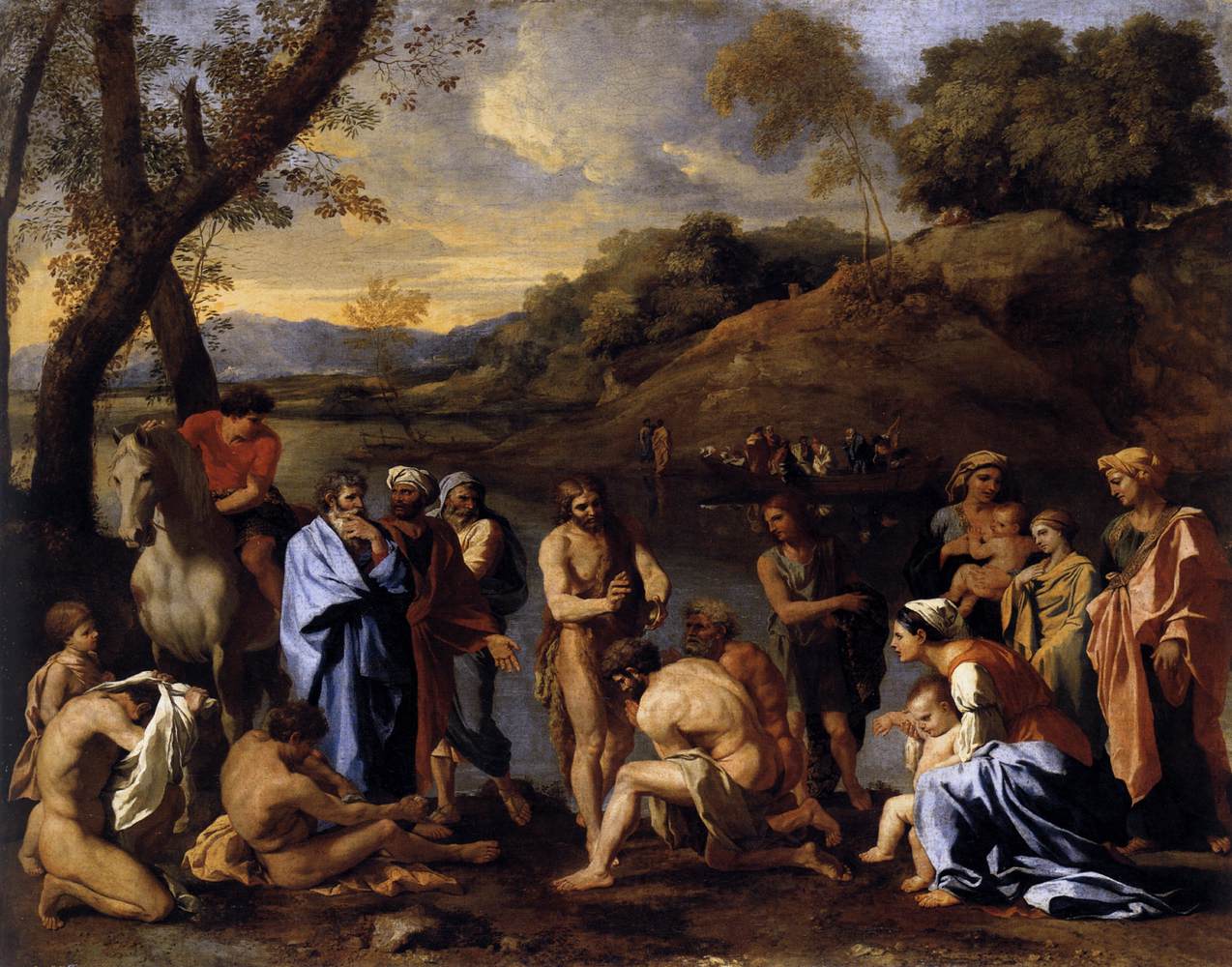
Nicolas Poussin, St. John the Baptist Baptizes the People, circa 1635
Oannes is not only depicted in religious paintings as the reincarnated John the Baptist. There are also modern accounts of Oannes’s depictions in art and literature. Recognized primarily for his literary masterpiece Madame Bovary, Gustave Flaubert worked thirty years on a lengthy retelling of the Temptation of Saint Anthony. In the books, Flaubert’s research of ancient creatures and gods are quite apparent. Oannes, was one of the creatures mentioned.
“Respect me! I am the contemporary of beginnings. I dwelt in that formless world where hermaphroditic creatures slumbered, under the weight of an opaque atmosphere, in the deeps of dark waters—when fingers, fins, and wings were blended, and eyes without heads were floating like mollusks, among human-faced bulls, and dog-footed serpents.”
As a visual companion to the piece, Odilon Redon, a French symbolist painter and printmaker, composed a series of illustrations on the temptation of St Anthony. I don’t want to get too deep into Redon’s illustrations, because I’ll probably delve deeper into Redon’s work in a later post. However, I do want to mention Redon’s Oannes illustration.

Odilon Redon, Oannès: Moi, la première conscience du chaos, j’ai surgi de l’abîme pour durcir la matière, pour régle (Oannès: I, the First Consciousness of Chaos, Arose from the Abyss to Harden Matter, to Regulate Form) from La Tentation de Sainte-Antoine (The Temptation of Saint Anthony) (plate XIV), 1896
Centuries after Berossus’ description, Oannes is yet again depicted in art. Surrounded by an abyss, Oannes is depicted as a simple head on a swirled tail-like body. Redon’s Oannes is a modern, dark, and grotesque rendering of the Oannes depictions on Babylonian architecture. I also think it is very interesting how the depiction of Oannes as the fish-god has evolved over time. As some point, he was regarded as the god of wisdom and education. In Redon’s title, he is considered the “Consciousness of Chaos.” “Consciousness of Chaos” essentially is knowledge, but the diction has attributed Oannes’s knowledge and skills to negativity.
This is possibly the first time that I have been so enamored with ancient mythology. I’ve always had an interest, but unlike this. As I type my final words, I also notice something –
Isn’t it odd how mermen have evolved in folklore and art? Oannes, as one of the earliest forms of a merman and fish-god, is depicted to be strong, knowledgeable, and even as the “First Consciousness of Chaos.” Quite powerful for a semi-human fish. On the other hand, the beautiful mermaids are only attributed to evil, floods, and shipwrecks…
Back to Oannes… He’s one interesting mythological character who, has constantly remained present, evolving in art, mythology, and literature. Art History interrelates with mythology and folklore, thus allowing people to study this evolution through visual imagery, whether they were depicted in ancient Babylon, Baroque France, or 19th century France.
 theUNTITLED