Disclaimer: This is still not a blog post on Leonardo di Caprio… Nor is it about Titanic or how his heart potentially shatters with every Oscar he is not awarded. This is still about our Renaissance man, avid corpse-dissector, brilliant artist and scientist Leonardo da Vinci.
“We may say that the Earth has a vital force of growth, and that its flesh is the soil; its bones are the successive strata of the rocks which form the mountains; its cartilage is the porous rock, its blood the veins of the waters. The lake of blood that lies around the heart is the ocean. Its breathing is the increase and decrease of the blood in the pulses, just as in the Earth it is the ebb and flow of the sea.” – Leonardo da Vinci
In my last blog post, I primarily discussed Leonardo da Vinci’s clear interest in anatomical studies and the relationship between art and science. In fact, Verrochio insisted that Leonardo study anatomy as an apprentice in his shop. Fast forward a few years to 1507, and Leonardo is dissecting and studying human corpses in numerous hospitals around Italy (with permission). However, before he began examining and sketching human corpses, Leonardo would sketch the organs of animals. The sketch below was done in 1512-1513, but still exemplifies Leo’s study methods.
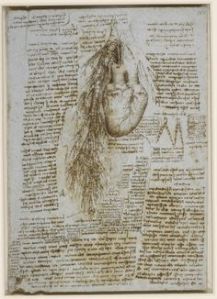
Leonardo da Vinci, Heart and Lungs of an Oxen, 1512-1513
Leonardo’s sketches of the human heart are not entirely accurate, but they do provide useful information about how the heart functions. Leo discovered that the heart is actually a muscle and believed that it pumps blood through our bodies. As a result of Leonardo’s sketches and studies, we found out that the heart consists of four chambers instead of two.
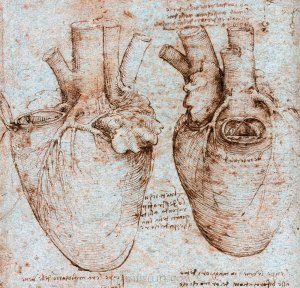
Leonardo da Vinci, Heart Sketches
Scientists continuously find uses for Leo’s sketches. In 2005, Dr. Francis Well, an English cardiac surgeon, revised a cardiac surgery procedure simply by revisiting Leo’s notes and sketches. By doing so, he successfully treated 300 patients by 2008. [Check out the lecture below, it’s absolutely fascinating!]
How could you describe this heart in words without filling a whole book? – Leonardo da Vinci
In my previous blog post, I mentioned that Leo believed that the physical qualities and the personality are connected, that physical beauty can reflect upon internal beauty. For instance, if you’re heart is a deep ocean of secrets, you might just have a mysterious and secretive physical look. [Thanks old lady from Titanic]
A dollop of Titanic since I keep mentioning hearts and Leo
Therefore, by constantly sketching anatomy, Leo is not just helping advance science, but sketching organs directly reflects upon his understanding the external human body as well. Internal and external bodily functions go hand in hand, and one cannot exist without the other [duh]. His anatomical studies were to complement his paintings. In fact, many of his anatomical sketches did not actually surface or become publicized until two and a half centuries after his death. Understanding the human body helped Leo understand how to translate three dimensional bodies onto a two dimensional surface. The folds on a subject’s neck, or the position of hands depend on the internal workings of the human body.

Thus, to conclude my two part blog on Leonardo: art and science go hand in hand. It’s unfortunate that often times this is overlooked, but revisiting Leo’s works only proves how one subject cannot exist without the other. Before I get into arts education propaganda again, I’m going to let the posts speak for themselves.
Fin.

 theUNTITLED