At a young age, I read the book “կայծեր (Sparks)” by Raffi, one of the legendary Armenian novelists. The novel was about young Armenian revolutionaries standing up and fighting for their rights. The chosen title name is very appropriate: when the hammer hits hot metal, it creates sparks. Those sparks were the revolutionary men standing up for what they believed in and pursuing it.
Without a doubt, the same can be said about avant-garde and non-conformist art under totalitarian rule. Under the pressures and limitations of totalitarian art arises legendary artists who create abstract visual commentaries that reflect upon on their lives and capture what is in their souls.
Just as Hitler attempted to silence abstract artists through humiliation (recall “Entartete Kunst [Degenerate Art]” and physically destroying artworks, the Soviet government silenced artists who strayed away from the USSR’s officially and only acceptable art style, Socialist Realism.
USSR, however, did not always silence artists. For the first decade, before the official decree of Socialist Realism, avant-garde artists, such as Alexander Rodchenko were dedicated to the USSR while having the freedom to explore avant-garde art.
The early twentieth century brought many social and political changes to Russia. The Russian Revolution of 1917, led by the Bolshevik leader Vladimir Lenin, promised a utopian egalitarian state with a Socialist government. The new Russian state promised social, political, and economic equality to the working class by overthrowing a previously bourgeois and hierarchical political system. As a newly emerged government that concentrated on the welfare and needs of the lower classes, it was inevitable that they also needed to recreate Russian culture to suite the needs of the general public. They attempted to restructure the arts with two specific goals. Art, which was once specifically reserved for the upper class, was made available for the enjoyment and use of the masses. Second, art was seen as a propaganda tool, convincing people to believe in the heroism of the Soviet government and leaders. Introduced in the 1920s and officially decreed in 1934, the newly emerged Soviet government introduced Socialist Realism as the sole official genre of art and literature. The Soviet Union expected art to depict Soviet reality in its dialectical qualities. For instance, the depiction of the triumphs of the working class and the process to get to the Revolution were primary subjects of artworks. Socialist Realism may have depicted what was real, which was the triumph of the working class over the upper class, but it did not depict the truth of Soviet life; the truth of Soviet life was poverty, hunger, and depression.
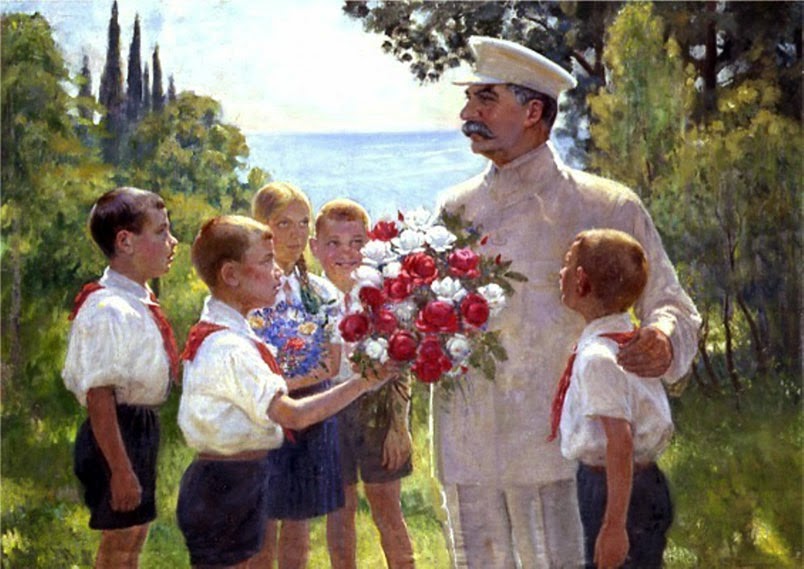
Boris Vladimirski, Roses for Stalin, 1949, oil on canvas
Socialist Realism was a method of idealizing reality and bending the truth to fit the needs of the Soviet government. Socialist Realism, although carefully chosen by the well educated and elite, was supposedly to emphasize the traditionalist tastes of the masses, returning art to classical techniques that attempted to represent reality “accurately.” With such traditional notions in mind, Socialist Realism was specifically aimed at painting.
Avant-garde and abstraction is far from reality, particularly the idealized reality that the USSR was demanding from artists. Artists who strayed away from Socialist Realism were condemned, exiled, tortured, or watched all their artworks burn to the ground.
One man, however, helped stop that. One man sent by the gods of avant-garde art attempted to save these artworks from such a tragic end. That man was Igor Savitsky. If the artist is going to be exiled and face inevitable death, then why not save their works?

Igor Savitsky is a fascinating figure in the history of Communist Art. Born in 1915 in Kiev, Igor Savitsky was the child of a quite wealthy family. During the October Revolution, Savitsky’s family was targeted and thus he hid his identity by “transforming” into a proletariat. He had always been interested in art, and created some artworks of his own. However, his artworks received heavy criticisms, and he eventually gave up painting altogether when he became the director of the Karakalpak Museum. However, he never lost his appreciation and love for avant-garde art, even though it was the works of others.
Savitsky began collecting millions of Russian and Central Asian avant-garde works and saving them in the deserts of Uzbekistan. Eventually, this desert oasis became an actual museum (Karakalpak Museum), housing over 90,000 artworks and various textiles, jewelry, and artifacts of Central Asian cultures. By convincing Soviet authorities that Karakalpakstan needed an art museum, he was given the funding and the position of founding director of the cultural institution.

However, art and heat do not mix well together. Thus, Savitsky single handedly tried to maintain his collected artworks, eventually leading to his own death. Imagine; working to preserve these artworks so tirelessly it became the reason for all your health issues. Even then, Savitsky did not stop his work. In the Moscow hospital were he spent the last days of his life, Savitsky continued his research and writings on art for the Karakalpak Museum.
Savitsky is a gem, an angel sent by the art gods to help preserve culture that was on the verge of extermination.
Hitler’s rejection from the art conservatory drove him to torture millions of people; Savitsky’s led him to save critical artworks of the underground Soviet avant-garde artists, even if they cost him his life.
I’m thankful for people like Savitsky; without him and other like-minded individuals, the world would not know about all the timeless avant-garde pieces that were created during the Soviet era.
If you’re interested in learning more about Igor Savitsky, I recommend watching the Desert of Forbidden Art by Amanda Pope, who happens to be a Professor of production at USC’s School of Cinematic Arts. I own the documentary myself, and I can honestly say it’s one of my favorite documentaries out there.




 theUNTITLED