He(art)

[My last few blog posts are all somewhat tied to each other… I must put an end to this, right after this post!]

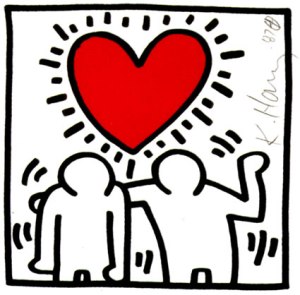
I’ve always fancied the anatomical heart as opposed to the cartoon-like heart symbol. Thanks to Leonardo da Vinci, we know that hearts consist of four chambers as opposed to two. That made me think about the two chambered heart we know and use so frequently now.

Untitled

Keith Haring, Untitled, 1987

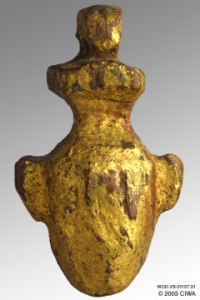
Knowledge of the human heart developed, but the symbolic significance of the heart remained the same. Ancient Egyptians, for instance, believed that the heart was an important organ that carries the human soul. When mummifying, the heart was not removed from the body. Emotions, feelings, actions, and memories were connected to the ib (heart) and thus heart symbols were created primarily to protect the deceased’s heart in the afterlife.

Egyptian gilded wooden heart amulet, 1570 BCE - 1293 BCE

Egyptian gilded wooden heart amulet, 1570 BCE – 1293 BCE

When observing alphabets, one can see that the heart had clear influence on the creation of alphabets. While the Georgian alphabet exemplifies the two chambered heart, the Chinese symbol for heart is a more realistic depiction of the heart, with four individual strokes representing four chambers of the heart. In addition, even the lower curvature is reminiscent of the anatomical heart.

"Ghan," 26th letter of Georgian Alphabet

“Ghan,” 26th letter of Georgian Alphabet

Chinese Symbol for Heart

Chinese Symbol for Heart

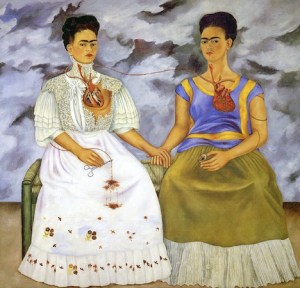
The heart still carries the same significance. Frida Kahlo’s 1939 painting The Two Fridas depicts two Fridas holding hands with their gaze directed towards the audience. The ladies are completely covered with the exception of the two vulnerable and exposed anatomical hearts, connected with a vein. Kahlo, most known for her self portraits, turned to art due to a bus accident that resulted in a state of immobility. With painting as an escape and pastime activity, Kahlo immersed herself into two-dimensional reflections of her mind, body, and soul. The Two Fridas was painted during the time of her divorce from Diego Rivera in 1939. The left Frida in a wedding-like white dress, sits bleeding with the insides of the heart exposed. The right Frida sits slouched, legs open, and a heart in tact with the external detailed heart. Both Frida’s faces are blankly gazing at the viewer – their bodies and particularly their exposed hearts are indicative of the turmoil during her divorce.  The most exposed parts of her body are the two hearts. stripped from all its protective layers – ribs, skin, clothes.

Frida Kahlo, The Two Fridas, 1939

Frida Kahlo, The Two Fridas, 1939

We most often hear that artists put their heart and soul into their artworks. The concepts that the heart stands for are repeated themes in many paintings. However, the actual depiction of anatomical and symbolic hearts in artworks become the focal point of the work of art, as seen in Keith Haring’s and Frida Kahlo’s paintings.


Leo’s Heart

Disclaimer: This is still not a blog post on Leonardo di Caprio… Nor is it about Titanic or how his heart potentially shatters with every Oscar he is not awarded. This is still about our Renaissance man, avid corpse-dissector, brilliant artist and scientist Leonardo da Vinci.

“We may say that the Earth has a vital force of growth, and that its flesh is the soil; its bones are the successive strata of the rocks which form the mountains; its cartilage is the porous rock, its blood the veins of the waters. The lake of blood that lies around the heart is the ocean. Its breathing is the increase and decrease of the blood in the pulses, just as in the Earth it is the ebb and flow of the sea.” – Leonardo da Vinci

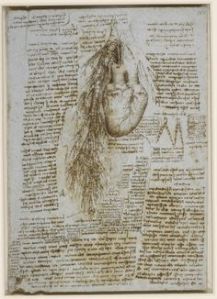
In my last blog post, I primarily discussed Leonardo da Vinci’s clear interest in anatomical studies and the relationship between art and science. In fact, Verrochio insisted that Leonardo study anatomy as an apprentice in his shop. Fast forward a few years to 1507, and Leonardo is dissecting and studying human corpses in numerous hospitals around Italy (with permission). However, before he began examining and sketching human corpses, Leonardo would sketch the organs of animals. The sketch below was done in 1512-1513, but still exemplifies Leo’s study methods.

Heart and Lungs of an Oxen

Leonardo da Vinci, Heart and Lungs of an Oxen, 1512-1513

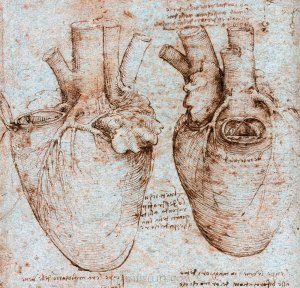
Leonardo’s sketches of the human heart are not entirely accurate, but they do provide useful information about how the heart functions. Leo discovered that the heart is actually a muscle and believed that it pumps blood through our bodies. As a result of Leonardo’s sketches and studies, we found out that the heart consists of four chambers instead of two.

tumblr_mb533beeEj1rff4lfo1_1280

Leonardo da Vinci, Heart Sketches

Scientists continuously find uses for Leo’s sketches. In 2005, Dr. Francis Well, an English cardiac surgeon, revised a cardiac surgery procedure simply by revisiting Leo’s notes and sketches. By doing so, he successfully treated 300 patients by 2008. [Check out the lecture below, it’s absolutely fascinating!]

How could you describe this heart in words without filling a whole book? – Leonardo da Vinci

In my previous blog post, I mentioned that Leo believed that the physical qualities and the personality are connected, that physical beauty can reflect upon internal beauty. For instance, if you’re heart is a deep ocean of secrets, you might just have a mysterious and secretive physical look. [Thanks old lady from Titanic]

A dollop of Titanic since I keep mentioning hearts and Leo

Therefore, by constantly sketching anatomy, Leo is not just helping advance science, but sketching organs directly reflects upon his understanding the external human body as well. Internal and external bodily functions go hand in hand, and one cannot exist without the other [duh]. His anatomical studies were to complement his paintings. In fact, many of his anatomical sketches did not actually surface or become publicized until two and a half centuries after his death. Understanding the human body helped Leo understand how to translate three dimensional bodies onto a two dimensional surface. The folds on a subject’s neck, or the position of hands depend on the internal workings of the human body.

Thus, to conclude my two part blog on Leonardo: art and science go hand in hand. It’s unfortunate that often times this is overlooked, but revisiting Leo’s works only proves how one subject cannot exist without the other. Before I get into arts education propaganda again, I’m going to let the posts speak for themselves.

Fin.

Leo’s Mind, Body, and Soul

Disclaimer: This blog post will not be about Leonardo DiCaprio. This is about the Leonardo that cut open over 30 corpses in approximately the last 11 years of his life…for science’s sake, of course.

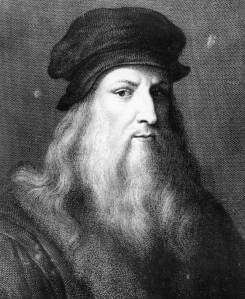
Leonardo da Vinci was born to a peasant mother and wealthy father out of wedlock in the Tuscan hilltown of Vinci in 1452. Because his parents were not married, and his mother was poor, he was not granted the right to a surname, just like his mother Caterina. Hence, his full name was Leonardo di ser Piero da Vinci. We think we have it tough nowadays, but this man’s full name was literally “Leonardo of sir Piero [his father] of the town of Vinci.” With no surname, Leonardo’s identity was completely tied to his father and his town. In fact, my Renaissance art professor always reminded us to stop calling him da Vinci because his actual name is Leonardo. da Vinci is only used as a surname to distinguish him from other Leonardos of his time.

LEONARDO

Leonardo da Vinci

Leo is now known for being a polymath, marking the beginning of the High Renaissance (according to Vasari), and providing conspiracy theorists with two of the greatest artworks to profit off of. [Especially you, Dan Brown. You are welcome.]

If I had to choose only one thing I appreciate about Leo’s contributions to the world, it would be the fact that he showed the codependent relationship between the arts and the sciences. Nowadays, people so easily throw out arts education for children, Leo is a good reminder that one subject cannot exist without the other. A lot has definitely changed since the late 1400’s! [WHERE ARE OUR PRIORITIES, GOVERNMENT?!]

Now that I’ve concluded my arts education propaganda, let me get back to my point.

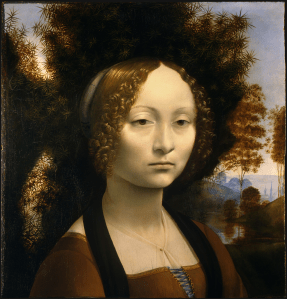
Leonardo strongly believed in the relationship of interior and exterior. So if Leo was alive now and heard a parent tell their child, “it’s what’s on the inside that counts,” he’d be the first to object and tell that parent that faces, shapes of skulls, and other physical qualities relate to one’s interior qualities. In addition, as a keen observer of the physical world, Leo also established a strong relationship between nature and the human. For instance, below is one of Leonardo’s earliest portrait commissions, Ginevra de’ Benci (1475).

Leonardo_da_Vinci,_Ginevra_de'_Benci,_1474-78

Leonardo da Vinci, Ginevra de’ Benci, 1475

Notice how the juniper tree perfectly encircles Ginevra’s face. The natural landscape in the background not only shows off Leonardo’s observational skills, but it perfectly balances the anatomy of the human subject. Directly parallel to Ginevra’s neck folds is a hollow space in the juniper tree. In addition, the branches extending outward on the right perfectly complement her curls as they gently caress her cheekbone.

The juniper tree, aside from providing a parallel to Ginevra’s anatomical features, is also a play on her name. Yes, dear readers, the juniper tree in Italian is a play on her name.

anigif_enhanced-buzz-12739-1357837210-1

So here enters the natural landscape’s third purpose: a symbolic notion of Mrs. Genevra’s identity. The portrait is not just a representative of the fair lady’s physical features, but it’s also intended to shed some light on who she was.

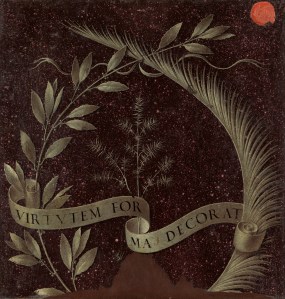
On the back of the painting is another painting connected to the subject of the portrait. However, this isn’t rare; many Renaissance portraits had paintings on the back.

Leonardo da Vinci, Ginevra

Leonardo da Vinci, Ginevra de’ Benci (back), 1475

Here, the juniper branch appears in the center of a laurel and palm branch, which represent the Venetian Bernardo Bembo, who wrote poetry and jousted for her. [Side note: Where are all the poetry writing and jousting men? Is chivalry REALLY dead?!] Wrapping around the three branches is a banner that says “Beauty adorns virtue,” as a reflection of her beauty, morality, and intellect. Once again, the physical beauty is weaved with her personality and intellect, unifying elements of a person that people are constantly trying to pull apart.

‘Tis true. I am biased because this is my favorite painting by Leonardo. The beauty, the composition, and the overall smokiness of the painting make Ginevra look so delicate. However, just like the Mona Lisa, our dear Ginevra’s gaze is directed towards the viewer,  changing the way that people perceived the upper class women of society. I have digressed.

Leonardo’s contributions to art and science are evident in almost all his works. Ginevra de’ Benci not only depicts the inner and outer beauty of an upper class woman, but it also captures the interconnectedness of the world.

To be continued next post…


Cemetery Drive

I’m embarrassed how long it’s taken me to get back into writing. I’m ashamed that I prioritized so many things that writing just slipped away. Since I graduated, I’ve been searching for clarity, peace of mind, or just something to hold onto. I wrote a couple of articles post graduation, but I still failed to keep up on all my grand plans. Complete exhaustion isn’t an excuse, but that’s what happened, unfortunately. It wasn’t until I wrote a blog post about Star Wars for work that I realized I need to begin writing for my own pleasure again. I’m rusty; I’m pretty disappointed in myself, but I must move on, right?

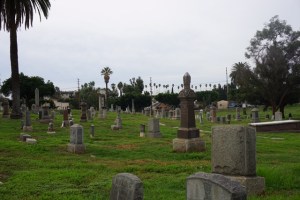
I bought a camera once I graduated with the hope of photographing landscapes. I thought my camera would be the reason why I begin exploring my own city. I was inspired by a high school friend who is a great nature photographer. Boy, was I wrong. Instead of exploring the city, I ended up in cemeteries. But then again, cemeteries are cities of their own.

Ani Mnatsakanyan

Ani Mnatsakanyan, Evergreen Cemetery, 2015.

I have always taken death lightly because I accepted its inevitability a long time ago. Photographing tombstones and cemetery landscapes was a cathartic experience for me as an art historian and as someone who just picked up a camera. I found peace within the overgrown weeds, broken angel sculptures, and mausoleums. I marveled at the beautifully morbid gallery of sculptures that adorned tombstones of loved ones, young and old.

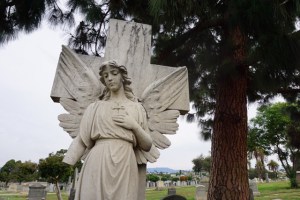
In cemeteries, the sculptors are nameless and their works are more susceptible to damage. In fact, it’s easy to overlook the effort that goes into creating tombstones. Generally people go to cemeteries to visit the graves of loved ones. Understandably, the last thing on their minds would be the tombstones and sculptures. In addition, cemeteries are seen as dark and depressing places, so tombstones and statues similarly fall into that category. As much as conservators work to maintain the tombstones, these works of art don’t always get the respect they may deserve from the general public. For instance, take a look at the following sculpture.

Ani Mnatsakanyan

Ani Mnatsakanyan, Evergreen Cemetery, 2015.

The angel’s eyes are cast downwards towards the deceased body, the white stone representing purity, and a [broken] right arm open as a gesture of comfort. This angel is as unique as a Renaissance painting of the Virgin Mary with Child, but to the person that must come face to face with the decaying body of a loved one, it eases the encounter.

To all the artists that sculpt the countless angels, crosses, busts, and other symbols without recognition, your work is appreciated. Whether or not you’re in art history books, you are on the art historical timeline. The living and the deceased survive around the artworks you create. While there’s no wall label crediting you, you are the reason why some people come to terms with death and find peace within the confines of the cemetery walls. The nightmare of physically losing somebody is eased as the work of art comforts the living. Cemeteries provide people like me a cathartic experience because of the artists that animate them with sculptures.

Breaking down Stalin’s Idealized Image

VItaly Komar (1943) and Alexander Melamid (1945) are Russian-born artists currently residing and working in the United States. Though they have been working independently since 2003/04, they spent most of their artistic career working as a duo. The artists got their start in Russia’s unofficial art scene, eventually migrated to Israel and then America in the pursuit for artistic freedom. Both artists have maintained the same style throughout all their different phases and have produced artworks filled with wit and intelligence, but their start as Sots-Artists are, in my opinion, the most significant contributions to the art world.

Sots-Art merged in the 1970s alongside Moscow Conceptualism. Both movements are reactions to their contemporary social, political, economic, and cultural problems in the USSR. Therefore, the reasons for the movements are the same, but each movement follows a separate path in regards to responding and finding answers to their problems. Each movement is complex in and of itself, as well as in relation to one another. In the most basic definition, Moscow Conceptualists are interested in researching and observing Soviet consciousness through Russian literary and philosophical traditions. On the other hand, Sots-Artists take on Soviet cultural artifacts and images of political figures in order to criticize the very elements that it consists of. Furthermore, Sots-Art is considered to be the Russian reaction to American Pop Art, but rather than strictly concentrating on commodity culture, it criticizes all aspects of Soviet life, which were, in a sense, commodified.

It is almost impossible to overlook all the similarities between Sots-Art and Pop Art. However, because Sots-Art emerged as an unofficial art under a totalitarian regime, the cultural significance of Sots-Art is arguably far greater. Sots-Art was considered a threat to the regime because it was seen as anti-Soviet, but the established Soviet avant-garde also disliked it because it blended the Soviet elements that unofficial artists were attempting to ignore. Therefore, binary categorization does not suit Sots-Art, which does not necessarily conform to either group of artistic creation.

Nostalgic Socialist Realism series (1981-83), for instance, took on traditional Soviet painting techniques and depicted typical Soviet subjects through a specific manner, which did not necessarily show the Soviet Union’s greatness (which art during the time was supposed to), but rather, diminished its perceived greatness.

Melamine and Komar, Stalin in Front of a Mirror (from Nostalgic Socialist Realism), tempera and oil on canvas, 1982-1983

Melamine and Komar, Stalin in Front of a Mirror (from Nostalgic Socialist Realism), tempera and oil on canvas, 1982-1983

Stalin in Front of a Mirror from Nostalgic Socialist Realism depicts the ideal Soviet leader in a not-so-ideal fashion. The painting is often paralleled with Georges de la Tour’s portrait Mary Magdalen with the Smoking Flame. Mary Magdalen is depicted in a dark and contemplative mood. Generally she is depicted as an old lady in ragged clothing, begging for mercy; de la Tour has eliminated any emphasis on materiality, which has generally been a significant aspect of how she is represented in portraiture. The overall mood of the painting makes her seem sorrowful and depressed. Melamid and Komar’s portrait of Stalin depicts the Great Leader in a similar fashion. While previous imagery of Stalin praised him, Melamid and Komar are equating him with a historically lower class citizen. Melamid and Komar broke down Stalin’s idealized image. He is depicted without shoes, arms crossed with wrinkles all over his face, hands, and feet. There are soviet elements in the painting, such as the bright red of the Communist party, but the dark aura and contemplative mood makes Stalin look weak and old.

Georges de la Tour, Mary Magdalen with Smoking Flame, oil on canvas, 1638-1640

Georges de la Tour, Mary Magdalen with Smoking Flame, oil on canvas, 1638-1640

On a side note: as I wrote this I kept thinking of Janice Ian in Mean Girls talking about taking down the Plastics. This is probably a poor analogy, but an entertaining one nevertheless. Imagine Stalin and his posse as the Plastics, and Melamid and Komar as Janice, Damian, and Cady…totally breaking down the system by incorporating elements of the same abusive system they want to abolish!

In every sense of the word, Melamid and Komar are truly revolutionary. The more I learn about them, the more intrigued I become. I’m also a sucker for artists boldly opening up a dialogue with oppressive political systems, which they were able to do with pure wits and talent.

Photography Allowed?

The emergence of smartphones and social media changed how people react to daily activities. Coffee shops provide the perfect latte for Instagram and LED lights at a club are a great backdrop to show Facebook friends how fantastic your Friday night was. Snapshots to preserve memories are not a new concept; the concept of preservation, whether it is posed or natural, has existed since the invention of the camera.  For instance, William Henry Fox Talbot’s photograph of his [almost] symmetrically organized china shelf is an example of photography for preservation.

William Henry Fox Talbot, Articles of China, 1843

William Henry Fox Talbot, Articles of China, 1843

The essence of photographing reveals the human desire to frame a fleeting moment in time and own that moment or object. Capturing an object within the lens of one’s camera makes the photographer an authority on the photograph and in a slight way, an authority of the object as well. The desire of authority is a strong pattern in modern photography, but social media and FOMO has started a trend of photographing as proof of one’s daily activities.

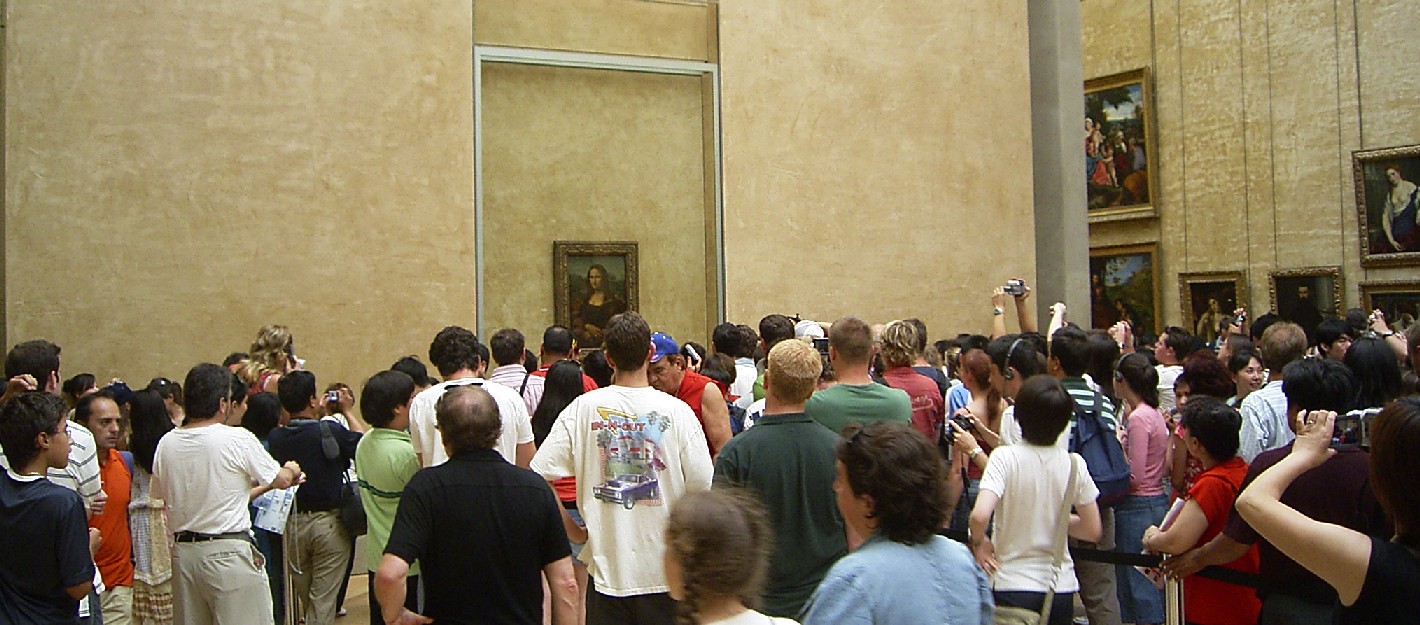
The same is not just applied to latte snapshots for Instagram friends to see, but photographing in museums as well. In the history of art, it is important to not only study the history and criticism of art and artworks, but also people’s interactions with art, especially with interferences like technology. Photographing art is not always allowed; some museums are fine with it if the collection is theirs and in stable condition. In certain exhibitions, a small image of a camera inside a circle with a line over it specifies exactly which photographs cannot be photographed.

I have a personal rule when I visit exhibits: If it is my first time seeing the exhibition, my cellphone remains in my purse unless I see an amazing image that I need to capture, whether it’s an artwork or an image of the entire gallery space. In general, I believe most museum goers are like that too; we are there to enjoy and experience the art. Our cellphones should only serve to enhance the trip rather than dominate the entire experience.

Mona_Lisa_Louvre

(I don’t have an image of my experience, but it parallels with people’s experience at the Louvre with the Mona Lisa.)


During my last trip to LACMA, however, I found myself analyzing the visitors more than the actual exhibit. Visitors in their fifties and sixties had their smartphones out obnoxiously snapping pictures of the paintings (with shutter sounds on…ON). However, more intriguing was the fact that they took about ten pictures of each painting and walked away without enjoying or viewing the painting. Photographing to preserve the memory of seeing a Van Gogh is understandable, but did they really see the painting? Did they actually enjoy the artwork or take a snapshot to prove they were there? If they did not actually experience the painting in real life, what purpose does a snapshot of it serve? If the privilege of observing details of a painting in person is provided, then there is no reason to photograph details and view them later; the internet allows us the opportunity to view details later on.

If the internet provides the public with the opportunity to view famous artwork digitally, then a museum visit’s purpose is not to simply ‘see art.’ Curatorial decisions enhance how we experience the art, allowing us to meditate upon, analyze, and question the artworks. A constant reliance on smartphones and snapshotting the memory rather than making a memory entirely eliminates the opportunity to experience everything else that the museum has worked so hard providing. Resisting the urge to snapshot every single experience can actually make the moment, well, memorable.

When Art Invades: Sculpture as Our Worst Nightmare?

Viewing sculpture is uncanny, active, and may even be irritating. For quite some time, sculpture was regarded as a secondary, or even decorative art form, as opposed to painting. The art of sculpture has evolved from Greek sculptures of Gods and Goddesses to the works of contemporary sculptors, such as Donald Judd and Carl Andre. Regardless of the artwork’s style, all sculptures have one thing in common; they take up physical space in our world.

Paintings hang on a wall; sculptures invade our spaces. If so, which of these two is more comforting to the viewer? Possibly, it is conventional paintings.

Of course, paintings take up physical space. However, a painting’s flatness cannot equate to the flamboyance of a sculpture’s form and rendering. Let me put it this way, paintings take up space, but sculpture invade and create awareness of spaces.

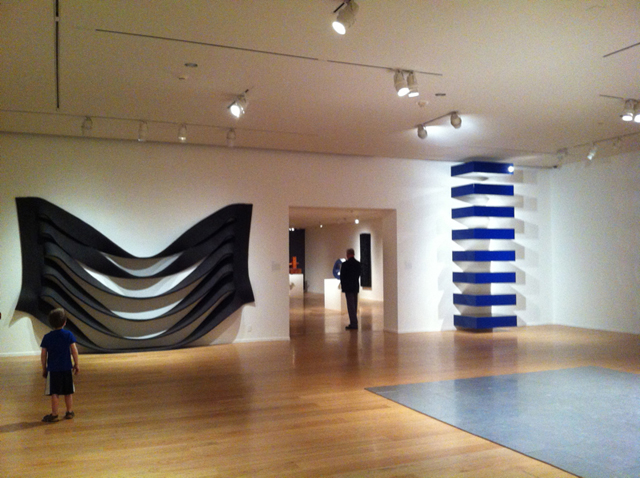
at130507gg

View of Norton Simon’s Beyond Brancusi show

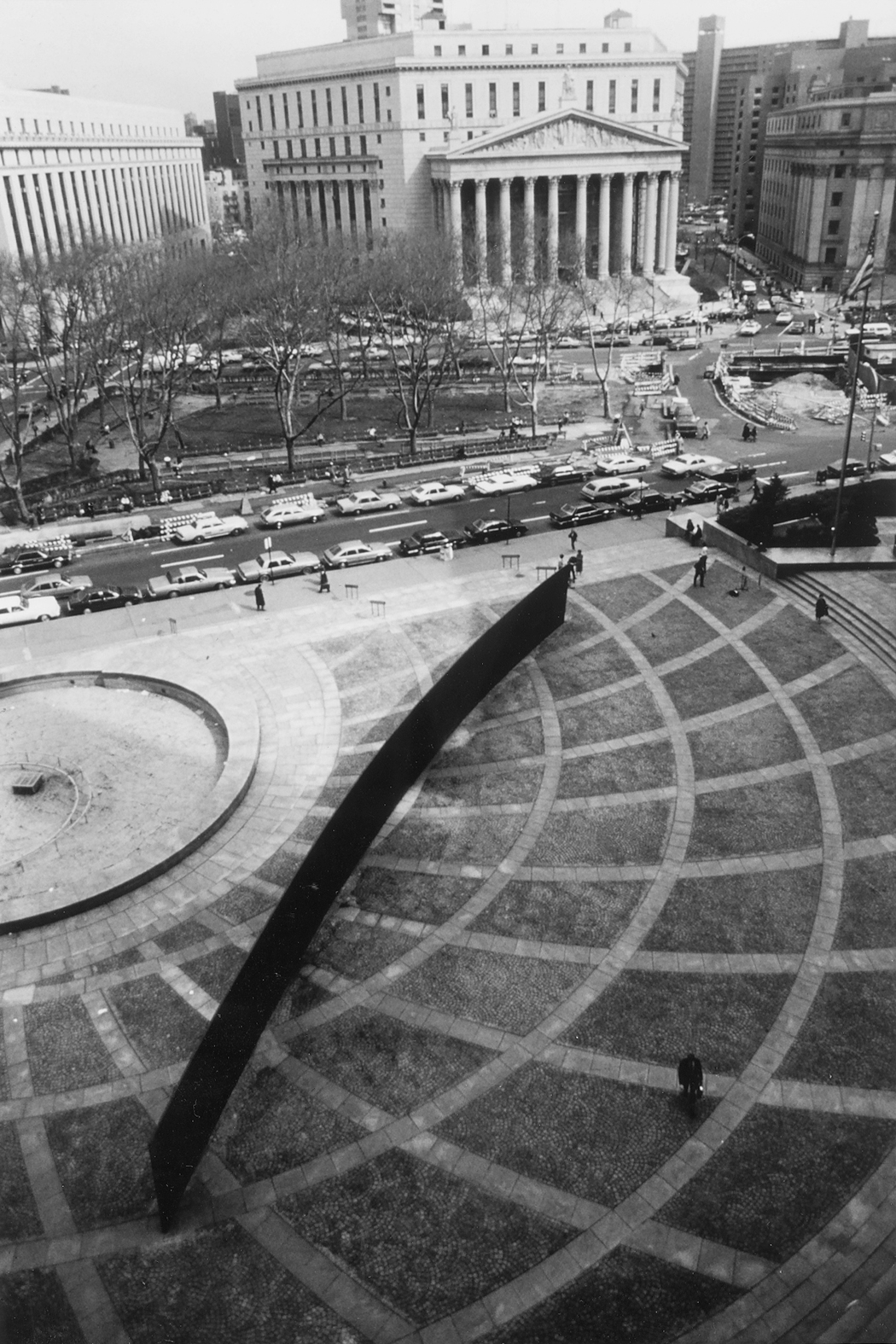
Generally, museums are open spaces with minimal seats and obstructions in one’s path. Visitors can gracefully sway from one painting to another and direct their gaze, as they please, to any part of a painting. In the act of viewing paintings, the issue of human superiority complex becomes more apparent than ever. Viewing painting is a very passive act and the human gaze can easily take over the painting. Viewing sculpture, on the other hand, is active and the sculpture’s physical existence can create a dialogue between the artwork and the viewer. The passivity of viewing painting also shuts us off from acknowledging our physical surroundings. On the other hand, sculpture makes us aware of our physical surroundings, because it obstructs the path to go from one place to another. Take for instance, Richard Serra’s famously controversial Tilted Arc. Serra contemplated on the area and the sculpture’s position for quite some time. He noted and recorded how people used the plaza and created a work that would enhance people’s daily experience. It was placed in the center of an old business plaza. The sculpture obstructed people’s physical space and forced people to become aware of where they go, how they get there, and what it means to physically exist in that space. Eventually, Tilted Arc was removed and the plaza became yet another boring location.

tiltedarc_big2

Richard Serra, Tilted Arc, 1981, view 1

late20th38-jpg

Richard Serra, Tilted Arc, 1981, aerial view


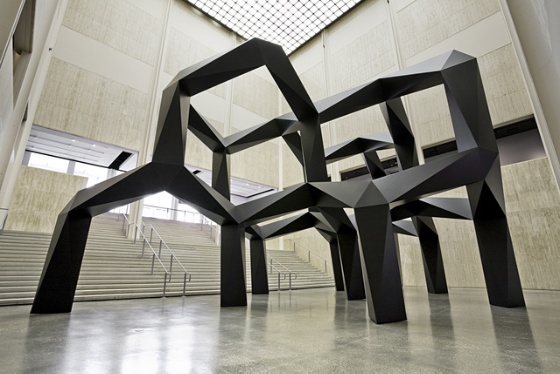
How dare this artwork physically exist in our space? Up to the moment of encountering sculpture, the museum visitor can walk around freely, looking at paintings from any distance and angle they would like. With a sculpture located in the gallery space, they must work around it to view other works. Sculpture is an obstruction and an unavoidable mass of ‘fat’ that makes viewers aware of the vast empty spaces surrounding the artwork. In fact, without the existence of the sculpture, the room’s space cannot be recognized. Without sculpture, space is not space. It is nothing, yet something at the same time. Emptiness can only be recognized with the presence of fullness. Therefore, when a sculptor creates physical masses of fat, it also creates the existence of empty spaces. Take for instance, Tony Smith’s Smoke. Walking through, you have no choice BUT to notice the hollow spaces, because each and every leg of the sculpture is an obstruction in the viewer’s space.


Tony Smith, Smoke, 1967

Tony Smith, Smoke, 1967


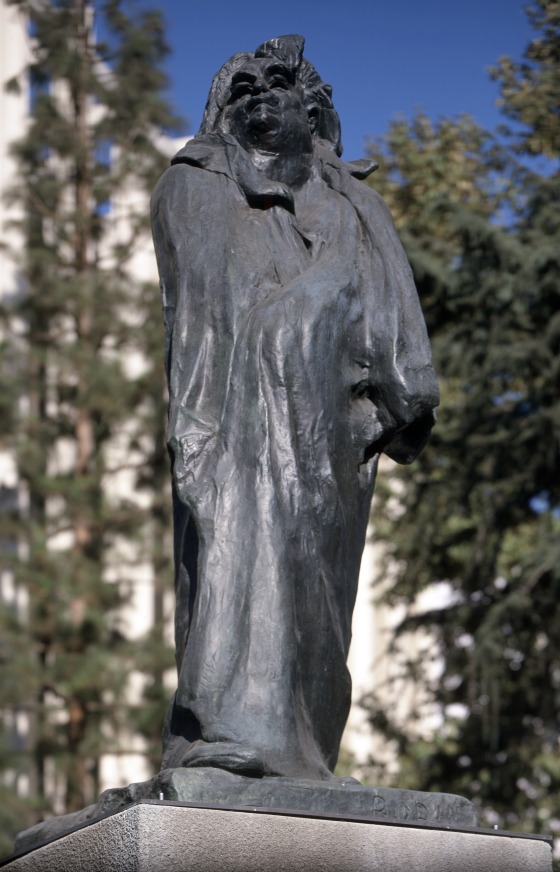
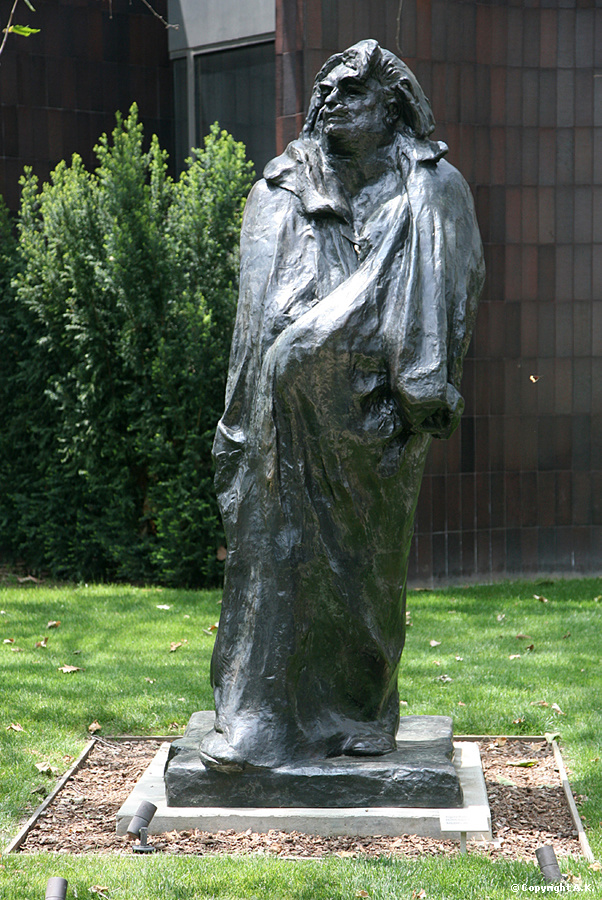
But invading space? One might wonder if my wording is a bit dramatic. In fact, I intend it to be. Rodin, a French sculptor (1840-1917), often times regarded as the predecessor of modern sculpture, challenged the barriers of traditional sculptural relationships to the audience and space. Due to the three dimensional nature of sculpture, particularly of figures, I understand that it is problematic to photograph sculptures in the round. Thus, I have here three images of Rodin’s Monument to Honore de Balzac from three different museums to give a sense of how the sculpture may look in the round.


ME0000088364_3

Auguste Rodin, Monument to Honore de Balzac, first modelled 1897

ma-33981685-WEB

Auguste Rodin, Monument to Honore de Balzac, first modelled 1897

ME0000120321_3

Auguste Rodin, Monument to Honore de Balzac, first modelled 1897


Paintings are restricted by their frame and canvas. Traditional sculptures are restricted by their base. Rodin [and Balzac] clearly choose to break free of this restriction. If the sculpture is viewed from the side, it is apparent that Rodin has provided ample space for Balzac’s monumental size. However, Balzac is depicted in a forward motion, with his right foot stepping out of the boundaries set by his base. Not only does the sculpture in its entirety obstruct the viewer’s space, but the figure is breaking the boundaries and challenging the limitations of sculptural figures. Rodin’s choice to extend the right foot out of the base places Balzac in a completely new realm of artwork-viewer relationships.


The role of sculpture is much more than ‘fillers’ or ‘secondary art’ in museum or public spaces. The uncanny qualities of sculpture prove time and time again how important the presence of sculpture is. It makes us aware of spaces, challenges how we view art, and may even help silence the superiority complex created when viewing painting.

Oannes: Evolution of the Fish-God

I was looking through the texts and research of the late Lester Bridaham at work, which he gathered for his famous book, Gargoyles, Chimeres, and the Grotesque in French Gothic Sculpture (reprinted by Dover Architecture as The Gargoyle Book: 572 Examples of Gothic Architecture). Bridaham had conducted extensive research on European Gothic architecture and mythological creatures, including basilisks, unicorns, and mermaids. On a small index card, he had written the name Oannes, which struck me immediately for many purposes. Firstly, I had not heard of such a myth before and I was tempted to learn more. Second, Oannes sounds just like Hovaness (Armenian for John), which is a common Armenian name. Until now, I assumed Hovaness is a Biblical name (John the Baptist). However, I had never known the history of the name goes back much further. And finally, Mr. Bridaham conducted research on Oannes because he was a merman; does this mean that Oaness may have been the first Merman in the history of mythology (at least that’s what Bridaham believes!)?

oannes[3]

Oannes depicted in an Egyptian style headdress

The story of Oannes was first documented by the Babylonian priest/writer Berossus, who wrote three books on the history and culture of Babylonia. His text served as an important source for later Greek historians, and thus his works survive only in fragments. Of the many things Berossus provided was his text on the fish-god Oannes, who has said to have resided in the Persian Gulf. Oannes was described to have the head of a fish and the legs of a man. Although in later times his description might have shifted to that of the mermen and mermaids we know today – a human’s torso and a fish’s tail. However, if you look closely at the detail on his head, you might notice that it is, in a sense, a fish head ‘hat.’ He rose from the sea every morning and taught mankind writing, art, and science, then proceeded to go back into the ocean at nights.
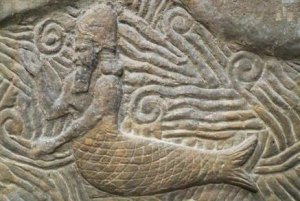
2881145

Oannes Relief

Ancient gods, no matter how ridiculous and unusual they may be to us, do not die out with the kingdom they belong to. [And I’m not just talking about ancient god/alien conspiracies!] Links between ancient religious deities are always present. For instance, Varuna, the water god of Vedism and in Hindu mythology, is almost identical to Oannes. Many times, Oannes was also depicted wearing an Egyptian style headdress in the form of a fish, rather than being half-human, half-fish.
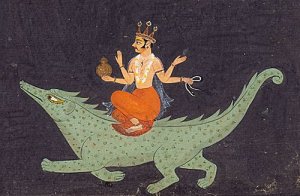
varuna

Varuna


The story of Oannes may even be where the story of John the Baptist originated from. John the Baptist is mentioned in many Western religious texted and is most widely known for his practice of Baptism to wash away all sins. Most visual depictions of John the Baptist show him near a body of water. Thus, there can only be a conclusion that there is a clear connection between the ancient Babylonian god of water and knowledge and John the Baptist.

John-the-Baptist-and-Jesus1

John the Baptist and Jesus

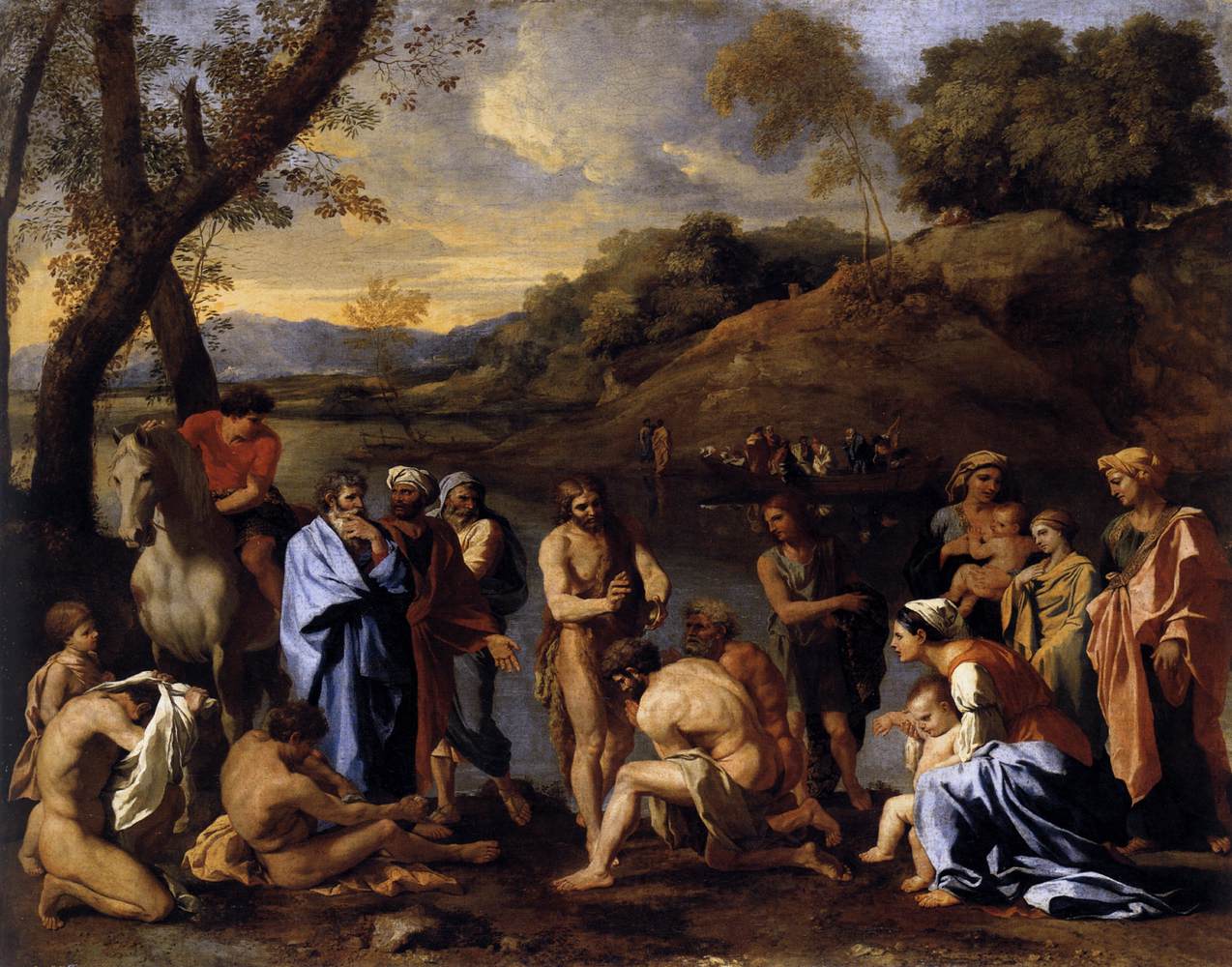
For instance, in this painting by Nicolas Poussin, a French baroque painter, Saint John the Baptist is baptizing citizens. Because people were illiterate, the best way to show Biblical stories was through imagery. In the center is Saint John. Even if the viewer was not familiar with religious figures, Poussin has positioned the bodies and gazes of surrounding figures towards St. John. Furthermore, just in case the viewer was wondering what in the world is Saint John’s story, Poussin had placed him near a body of water to make the relation clear. Therefore, St. John the Baptist is the Biblical reincarnation of Oannes.
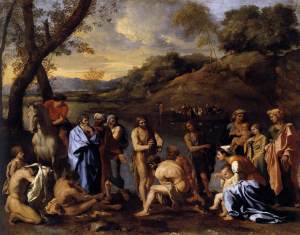
Nicolas_Poussin_-_St_John_the_Baptist_Baptizes_the_People_-_WGA18294

Nicolas Poussin, St. John the Baptist Baptizes the People, circa 1635

Oannes is not only depicted in religious paintings as the reincarnated John the Baptist. There are also modern accounts of Oannes’s depictions in art and literature. Recognized primarily for his literary masterpiece Madame Bovary, Gustave Flaubert worked thirty years on a lengthy retelling of the Temptation of Saint Anthony. In the books, Flaubert’s research of ancient creatures and gods are quite apparent. Oannes, was one of the creatures mentioned.

“Respect me! I am the contemporary of beginnings. I dwelt in that formless world where hermaphroditic creatures slumbered, under the weight of an opaque atmosphere, in the deeps of dark waters—when fingers, fins, and wings were blended, and eyes without heads were floating like mollusks, among human-faced bulls, and dog-footed serpents.”

As a visual companion to the piece, Odilon Redon, a French symbolist painter and printmaker, composed a series of illustrations on the temptation of St Anthony. I don’t want to get too deep into Redon’s illustrations, because I’ll probably delve deeper into Redon’s work in a later post. However, I do want to mention Redon’s Oannes illustration.
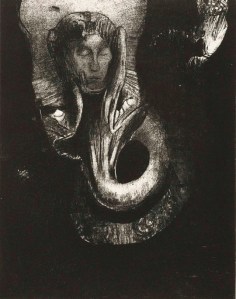
 

Odilon Redon, Oannès: Moi, la première conscience du chaos, j'ai surgi de l'abîme pour durcir la matière, pour régle (Oannès: I, the First Consciousness of Chaos, Arose from the Abyss to Harden Matter, to Regulate Form) from La Tentation de Sainte-Antoine (The Temptation of Saint Anthony) (plate XIV), 1896

Odilon Redon, Oannès: Moi, la première conscience du chaos, j’ai surgi de l’abîme pour durcir la matière, pour régle (Oannès: I, the First Consciousness of Chaos, Arose from the Abyss to Harden Matter, to Regulate Form) from La Tentation de Sainte-Antoine (The Temptation of Saint Anthony) (plate XIV), 1896

Centuries after Berossus’ description, Oannes is yet again depicted in art. Surrounded by an abyss, Oannes is depicted as a simple head on a swirled tail-like body. Redon’s Oannes is a modern, dark, and grotesque rendering of the Oannes depictions on Babylonian architecture. I also think it is very interesting how the depiction of Oannes as the fish-god has evolved over time. As some point, he was regarded as the god of wisdom and education. In Redon’s title, he is considered the “Consciousness of Chaos.” “Consciousness of Chaos” essentially is knowledge, but the diction has attributed Oannes’s knowledge and skills to negativity.


This is possibly the first time that I have been so enamored with ancient mythology. I’ve always had an interest, but unlike this. As I type my final words, I also notice something –

Isn’t it odd how mermen have evolved in folklore and art? Oannes, as one of the earliest forms of a merman and fish-god, is depicted to be strong, knowledgeable, and even as the “First Consciousness of Chaos.” Quite powerful for a semi-human fish. On the other hand, the beautiful mermaids are only attributed to evil, floods, and shipwrecks…


Back to Oannes… He’s one interesting mythological character who, has constantly remained present, evolving in art, mythology, and literature. Art History interrelates with mythology and folklore, thus allowing people to study this evolution through visual imagery, whether they were depicted in ancient Babylon, Baroque France, or 19th century France.
When Painting Died

When looking at art, what does one first look at? Subject matter, form, technique, colors? The beauty of having control of the canvas is that the artist also has control of what to emphasize in the work.

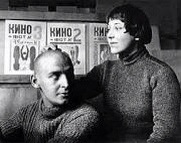
Alexander Rodchenko, a Russian avant-garde artist, was born in St. Petersburg to a working class family in 1891. As a child of a working class family, he truly believed in the Communist cause, he eventually gave up paining in favor of photography in the 1920s.

20140526-120821-43701746.jpg

Alexander Rodchenko and his wife, 1920s

Rodchenko was one of the early figures of the Constructivist movement, alongside his wife Varvara Stepanova. The term “Constructivism” was not actually used until the October Revolution of 1917. Constructivism also had a more industrial ring to it, straying away from the compositional nature of art that they were trying to avoid. Constructivism meant to heighten spacial and constructivist elements of art in an era of technological advancements, rather than flaunting ostentatious and unnecessary details in art. Constructivism in Russia was initially started by Vladimir Tatlin in 1914, and continued by Alexander Rodchenko and his counterparts.

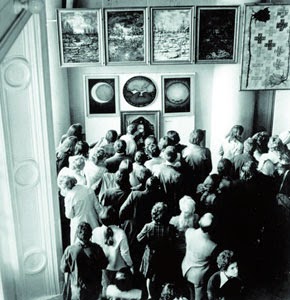
The 5×5=25 exhibition, which included artists Rodchenko, Varvara Stepanova, Lyubov Popova, and constructivists, introduced the new reality of art working in accordance with the Communist ideologies. Paintings were included in the exhibition, but only if they were sketches for spacial compositions or served a Constructivist purpose.
20140526-120923-43763789.jpg

Alexander Vesnin, 5×5=25 Exhibition catalogue cover

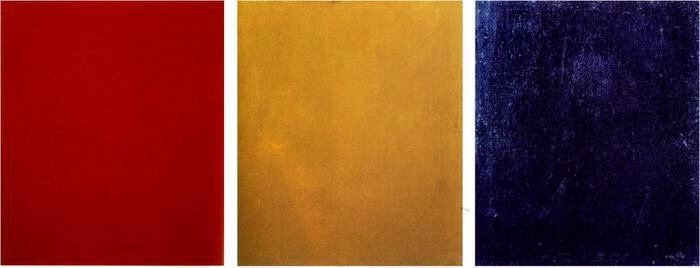
In 1921, Rodchenko painted Pure Red Color, Pure Yellow Color, and Pure Blue Color , as his last three paintings, which were a part of the 5×5=25 exhibition. In an era filled with pure egalitarian hopes and expectations, Rodchenko believed that traditional methods of painting and sculpting were dead and bourgeois. Years later, Rodchenko recalled that the monochromatic triptych was the representation of the essence of painting in the purest state, as well as the end of painting for himself and in general.
I reduced painting to its logical conclusion and exhibited three canvases: red, blue and yellow. I affirmed: it’s all over.
Basic colors.
Every plane is a plane and there is to be no representation.

20140526-121058-43858299.jpg

Alexander Rodchenko, Pure Red Color, Pure Blue Color, Pure Yellow Color, 1921

Painting is in essence, basic colors. Rodchenko’s triptych of the early twentieth century is a great representative piece of the end of painting in the traditional sense. The Constructivist movement is one of the final greatest movements in Russia before the emergence of Socialist Realism as the sole art form of the USSR.

Rodchenko’s triptych is a predecessor to Minimalism and monochromatic paintings. Although some similarities exist between future monochromatic paintings and Rodchenko’s triptych, the essence of Rodchenko’s “Pure” paintings is political. Even if the system was a failed experiment, artists truly believed in the cause and were completely dedicated their art to the promotion of a Communist state.


As Rodchenko said, “artists are catalysts for social change.”

The Bulldozer Exhibition: Aritst Exposure Gone Wrong

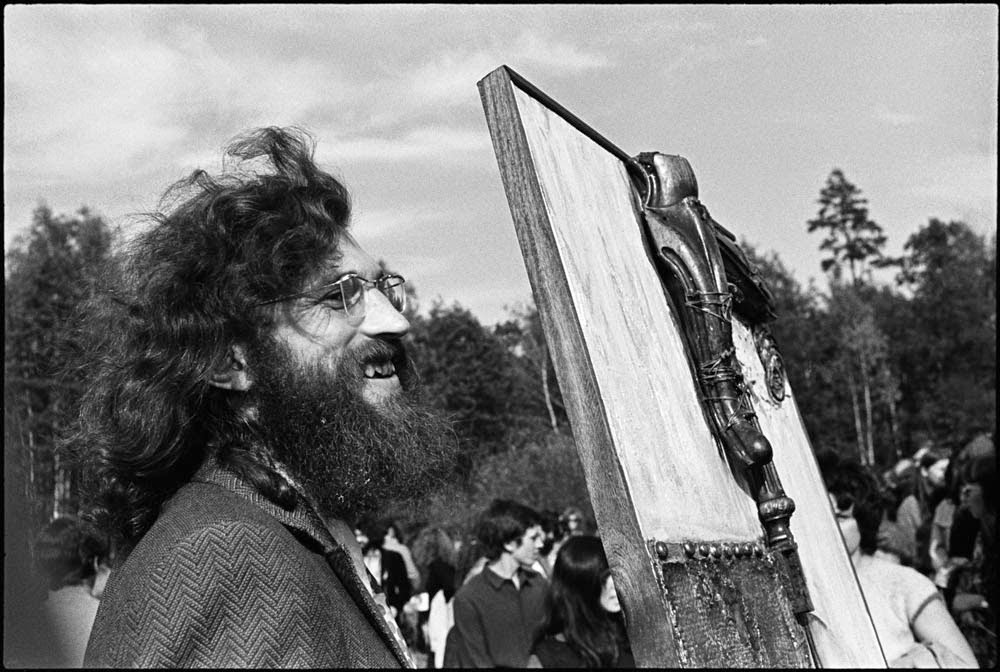
On September 15, 1974, a group of Soviet non-conformist artists gathered in an empty lot in Belyayevo. This group of artists, led by Oscar Rabin and Evgeny Rukhin, attempting to finally expose the works of underground and unofficial artists of the USSR. “Unofficial” artists of the USSR were those who dared to work against the only acceptable style of art in the Soviet Union, Socialist Realism. Since its official acceptance as the sole artistic style of the USSR, artists were given the choice between working with and for the government or dealing with the consequences of working against them. Many artists began working against the grain in secrecy and holding small exhibitions in their apartments, mainly attracting other artists and relatives. Apartment exhibitions required cautious execution, in order to avoid any trouble with the KGB. Therefore, actually having an exhibition in a vacant lot was an important affair.

Group of unofficial artists, the Moscow Conceptualists  

Unofficial artist Koryun Nahapetyan’s art exhibit in his apartment

The ill-fated exhibition’s name, the Bulldozer Exhibition, reflects upon the incidents that occurred during the only day of exhibiting art. The irony is that artists asked for legal permission and received it! They were told that the lot is available for use and the display of their modern and avant-garde works is not a worrisome matter. Little did these artists know that their works would be destroyed so quickly.

Water truck documented attacking the exhibition visitors

Using bulldozers, water trucks, and dump trucks, Soviet authorities pillaged the vacant lot, destroying most of the art and injuring artists, journalists, and innocent bystanders. Authorities beat and arrested artists and journalists, including three American correspondents. As this was the first time unofficial artists attempted to exhibit artwork in the public, news of the Bulldozer exhibition spread quickly, causing much distress to art lovers across the globe. Dissatisfaction with the happenings were brought to the Soviet’s attention, and in a pity attempt to fix their mistake, they offered the artists an empty space to display their art on a Saturday. Rabin refused, stating that Sunday would be the only acceptable day for their exhibition.

Oscar Rabin, Bouquet of Daisies, oil on canvas, 1969 

For decades, the USSR has persecuted, imprisoned, exiled, and arranged “accidental” deaths for numerous artists, writers, and thinkers. So how, after decades of oppression and murders and cover ups, can Soviet authorities even attempt to fix their mistake? Clearly, they were decades late in attempting to find peace with avant-garde artists exploring modern movements.

Side note: These artists, writers, and thinkers included Evgeny Rukhin (artist; reports say he died of carbon monoxide poisoning, although his wife believes this is another KGB cover up), Koryun Nahapetian (artist; shot in his studio in 1999, after the collapse of USSR, though some believe it is still related), Sergei Parajanov (artist and filmmaker; falsely imprisoned for many unnecessary reasons), Paruyr Sevak (poet; said to have died of a car crash, although people believe it was another KGB cover up). [These are simply names I can think of on the top of my head]

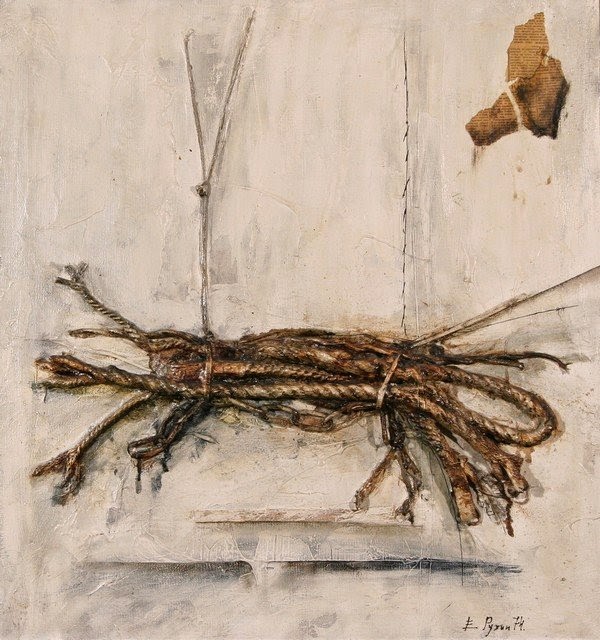
Evgeny Rukhin

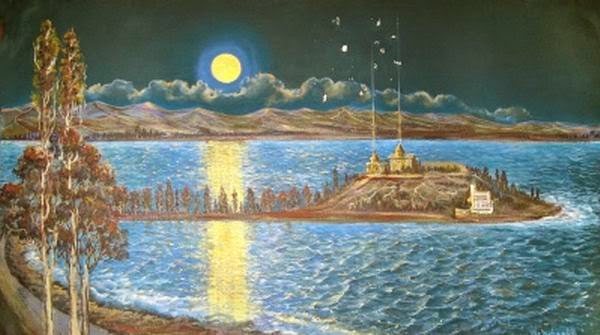
Koryun Nahapetian, Lake Sevan 

Not so fun fact: When Koryun Nahapetian was shot in his studio in 1999, this painting was in the studio. There are holes in the painting as a result of the gunshots.

Evgeny Rukhin, Untitled, mixed media on canvas, 1974

The Bulldozer Exhibition is a crucial page in history. When I speak about my avid interest in USSR official and unofficial art to people, I find that some are uncomfortable with my interests, assuming that I agree with the actions of the Soviet Union. I do not; I believe in the cause of the underground and unofficial artists, and I commend and respect all the selfless artists who have dedicated their work and their lives to the advancement of modern art in a society that shunned all nonconformists. Artists that have died in the hands of Soviet authorities, artists who attempted to escape the USSR and come to America, and artists who saw hundreds of their artworks burn in front of their eyes; some are rarely discussed. For instance, Koryun Nahapetyan who is an amazing nonconformist artist, a sociologist, a philosopher, and a political activist who took part in the Bulldozer Exhibition, has a short biography on Wikipedia and nothing else. Evgeny Rukhin, one of the organizers of the Bulldozer exhibition, similarly only has a minimal amount of information online.These artists deserve more; all the work they have done in their lifetimes is buried underneath the red-plagued Siberian snow.

Unofficial art history is still history. Bulldozers can ruin artworks and gunshots can kill people, but the message will always carry on.