[My last few blog posts are all somewhat tied to each other… I must put an end to this, right after this post!]
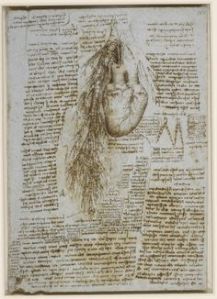
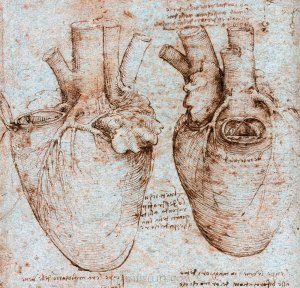
I’ve always fancied the anatomical heart as opposed to the cartoon-like heart symbol. Thanks to Leonardo da Vinci, we know that hearts consist of four chambers as opposed to two. That made me think about the two chambered heart we know and use so frequently now.
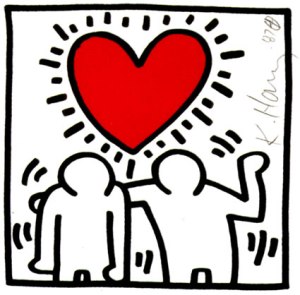
Keith Haring, Untitled, 1987
Knowledge of the human heart developed, but the symbolic significance of the heart remained the same. Ancient Egyptians, for instance, believed that the heart was an important organ that carries the human soul. When mummifying, the heart was not removed from the body. Emotions, feelings, actions, and memories were connected to the ib (heart) and thus heart symbols were created primarily to protect the deceased’s heart in the afterlife.
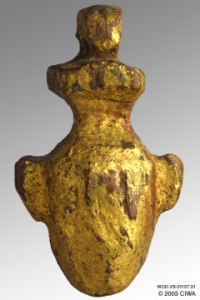
Egyptian gilded wooden heart amulet, 1570 BCE – 1293 BCE
When observing alphabets, one can see that the heart had clear influence on the creation of alphabets. While the Georgian alphabet exemplifies the two chambered heart, the Chinese symbol for heart is a more realistic depiction of the heart, with four individual strokes representing four chambers of the heart. In addition, even the lower curvature is reminiscent of the anatomical heart.
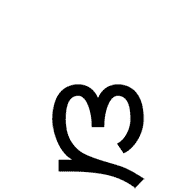
“Ghan,” 26th letter of Georgian Alphabet
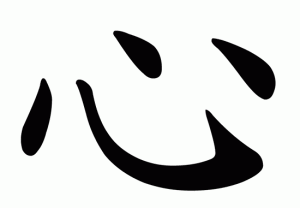
Chinese Symbol for Heart
The heart still carries the same significance. Frida Kahlo’s 1939 painting The Two Fridas depicts two Fridas holding hands with their gaze directed towards the audience. The ladies are completely covered with the exception of the two vulnerable and exposed anatomical hearts, connected with a vein. Kahlo, most known for her self portraits, turned to art due to a bus accident that resulted in a state of immobility. With painting as an escape and pastime activity, Kahlo immersed herself into two-dimensional reflections of her mind, body, and soul. The Two Fridas was painted during the time of her divorce from Diego Rivera in 1939. The left Frida in a wedding-like white dress, sits bleeding with the insides of the heart exposed. The right Frida sits slouched, legs open, and a heart in tact with the external detailed heart. Both Frida’s faces are blankly gazing at the viewer – their bodies and particularly their exposed hearts are indicative of the turmoil during her divorce. The most exposed parts of her body are the two hearts. stripped from all its protective layers – ribs, skin, clothes.
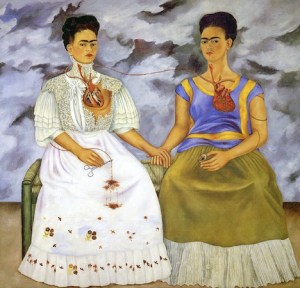
Frida Kahlo, The Two Fridas, 1939
We most often hear that artists put their heart and soul into their artworks. The concepts that the heart stands for are repeated themes in many paintings. However, the actual depiction of anatomical and symbolic hearts in artworks become the focal point of the work of art, as seen in Keith Haring’s and Frida Kahlo’s paintings.



 theUNTITLED