Disclaimer: This blog post will not be about Leonardo DiCaprio. This is about the Leonardo that cut open over 30 corpses in approximately the last 11 years of his life…for science’s sake, of course.
Leonardo da Vinci was born to a peasant mother and wealthy father out of wedlock in the Tuscan hilltown of Vinci in 1452. Because his parents were not married, and his mother was poor, he was not granted the right to a surname, just like his mother Caterina. Hence, his full name was Leonardo di ser Piero da Vinci. We think we have it tough nowadays, but this man’s full name was literally “Leonardo of sir Piero [his father] of the town of Vinci.” With no surname, Leonardo’s identity was completely tied to his father and his town. In fact, my Renaissance art professor always reminded us to stop calling him da Vinci because his actual name is Leonardo. da Vinci is only used as a surname to distinguish him from other Leonardos of his time.
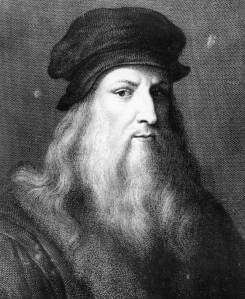
Leonardo da Vinci
Leo is now known for being a polymath, marking the beginning of the High Renaissance (according to Vasari), and providing conspiracy theorists with two of the greatest artworks to profit off of. [Especially you, Dan Brown. You are welcome.]
If I had to choose only one thing I appreciate about Leo’s contributions to the world, it would be the fact that he showed the codependent relationship between the arts and the sciences. Nowadays, people so easily throw out arts education for children, Leo is a good reminder that one subject cannot exist without the other. A lot has definitely changed since the late 1400’s! [WHERE ARE OUR PRIORITIES, GOVERNMENT?!]
Now that I’ve concluded my arts education propaganda, let me get back to my point.
Leonardo strongly believed in the relationship of interior and exterior. So if Leo was alive now and heard a parent tell their child, “it’s what’s on the inside that counts,” he’d be the first to object and tell that parent that faces, shapes of skulls, and other physical qualities relate to one’s interior qualities. In addition, as a keen observer of the physical world, Leo also established a strong relationship between nature and the human. For instance, below is one of Leonardo’s earliest portrait commissions, Ginevra de’ Benci (1475).
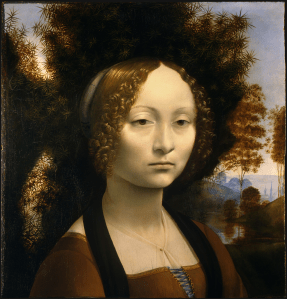
Leonardo da Vinci, Ginevra de’ Benci, 1475
Notice how the juniper tree perfectly encircles Ginevra’s face. The natural landscape in the background not only shows off Leonardo’s observational skills, but it perfectly balances the anatomy of the human subject. Directly parallel to Ginevra’s neck folds is a hollow space in the juniper tree. In addition, the branches extending outward on the right perfectly complement her curls as they gently caress her cheekbone.
The juniper tree, aside from providing a parallel to Ginevra’s anatomical features, is also a play on her name. Yes, dear readers, the juniper tree in Italian is a play on her name.

So here enters the natural landscape’s third purpose: a symbolic notion of Mrs. Genevra’s identity. The portrait is not just a representative of the fair lady’s physical features, but it’s also intended to shed some light on who she was.
On the back of the painting is another painting connected to the subject of the portrait. However, this isn’t rare; many Renaissance portraits had paintings on the back.
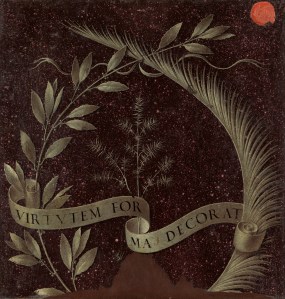
Leonardo da Vinci, Ginevra de’ Benci (back), 1475
Here, the juniper branch appears in the center of a laurel and palm branch, which represent the Venetian Bernardo Bembo, who wrote poetry and jousted for her. [Side note: Where are all the poetry writing and jousting men? Is chivalry REALLY dead?!] Wrapping around the three branches is a banner that says “Beauty adorns virtue,” as a reflection of her beauty, morality, and intellect. Once again, the physical beauty is weaved with her personality and intellect, unifying elements of a person that people are constantly trying to pull apart.
‘Tis true. I am biased because this is my favorite painting by Leonardo. The beauty, the composition, and the overall smokiness of the painting make Ginevra look so delicate. However, just like the Mona Lisa, our dear Ginevra’s gaze is directed towards the viewer, changing the way that people perceived the upper class women of society. I have digressed.
Leonardo’s contributions to art and science are evident in almost all his works. Ginevra de’ Benci not only depicts the inner and outer beauty of an upper class woman, but it also captures the interconnectedness of the world.
To be continued next post…
 theUNTITLED