The emergence of smartphones and social media changed how people react to daily activities. Coffee shops provide the perfect latte for Instagram and LED lights at a club are a great backdrop to show Facebook friends how fantastic your Friday night was. Snapshots to preserve memories are not a new concept; the concept of preservation, whether it is posed or natural, has existed since the invention of the camera. For instance, William Henry Fox Talbot’s photograph of his [almost] symmetrically organized china shelf is an example of photography for preservation.

William Henry Fox Talbot, Articles of China, 1843
The essence of photographing reveals the human desire to frame a fleeting moment in time and own that moment or object. Capturing an object within the lens of one’s camera makes the photographer an authority on the photograph and in a slight way, an authority of the object as well. The desire of authority is a strong pattern in modern photography, but social media and FOMO has started a trend of photographing as proof of one’s daily activities.
The same is not just applied to latte snapshots for Instagram friends to see, but photographing in museums as well. In the history of art, it is important to not only study the history and criticism of art and artworks, but also people’s interactions with art, especially with interferences like technology. Photographing art is not always allowed; some museums are fine with it if the collection is theirs and in stable condition. In certain exhibitions, a small image of a camera inside a circle with a line over it specifies exactly which photographs cannot be photographed.
I have a personal rule when I visit exhibits: If it is my first time seeing the exhibition, my cellphone remains in my purse unless I see an amazing image that I need to capture, whether it’s an artwork or an image of the entire gallery space. In general, I believe most museum goers are like that too; we are there to enjoy and experience the art. Our cellphones should only serve to enhance the trip rather than dominate the entire experience.
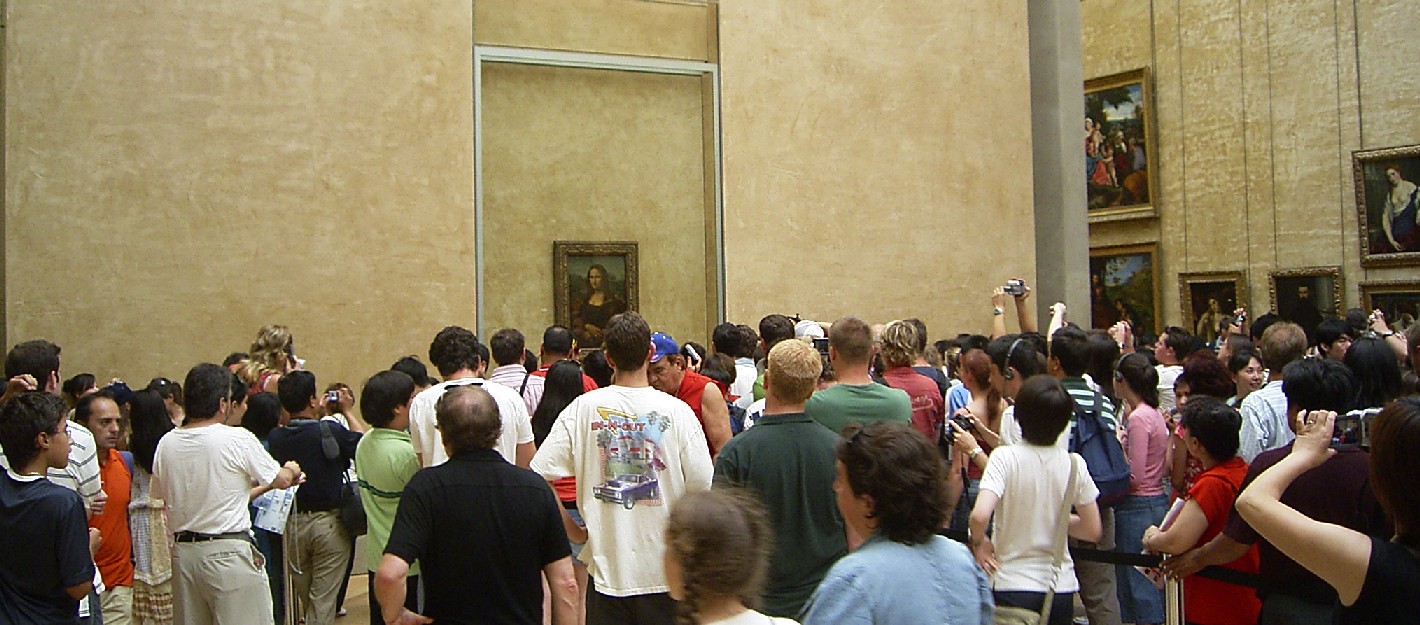
(I don’t have an image of my experience, but it parallels with people’s experience at the Louvre with the Mona Lisa.)
During my last trip to LACMA, however, I found myself analyzing the visitors more than the actual exhibit. Visitors in their fifties and sixties had their smartphones out obnoxiously snapping pictures of the paintings (with shutter sounds on…ON). However, more intriguing was the fact that they took about ten pictures of each painting and walked away without enjoying or viewing the painting. Photographing to preserve the memory of seeing a Van Gogh is understandable, but did they really see the painting? Did they actually enjoy the artwork or take a snapshot to prove they were there? If they did not actually experience the painting in real life, what purpose does a snapshot of it serve? If the privilege of observing details of a painting in person is provided, then there is no reason to photograph details and view them later; the internet allows us the opportunity to view details later on.
If the internet provides the public with the opportunity to view famous artwork digitally, then a museum visit’s purpose is not to simply ‘see art.’ Curatorial decisions enhance how we experience the art, allowing us to meditate upon, analyze, and question the artworks. A constant reliance on smartphones and snapshotting the memory rather than making a memory entirely eliminates the opportunity to experience everything else that the museum has worked so hard providing. Resisting the urge to snapshot every single experience can actually make the moment, well, memorable.
 theUNTITLED