Viewing sculpture is uncanny, active, and may even be irritating. For quite some time, sculpture was regarded as a secondary, or even decorative art form, as opposed to painting. The art of sculpture has evolved from Greek sculptures of Gods and Goddesses to the works of contemporary sculptors, such as Donald Judd and Carl Andre. Regardless of the artwork’s style, all sculptures have one thing in common; they take up physical space in our world.
Paintings hang on a wall; sculptures invade our spaces. If so, which of these two is more comforting to the viewer? Possibly, it is conventional paintings.
Of course, paintings take up physical space. However, a painting’s flatness cannot equate to the flamboyance of a sculpture’s form and rendering. Let me put it this way, paintings take up space, but sculpture invade and create awareness of spaces.
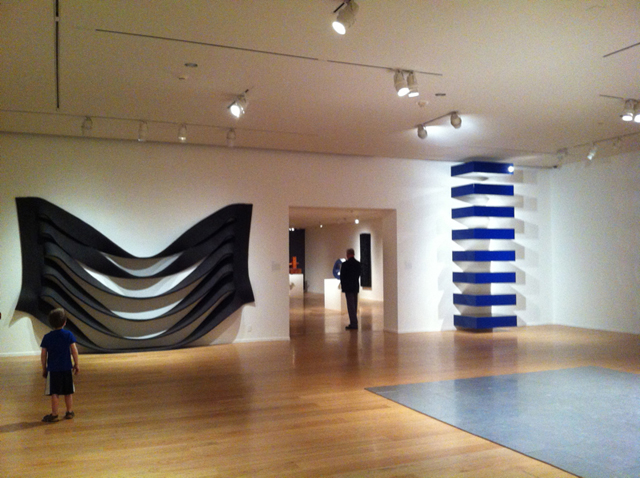
View of Norton Simon’s Beyond Brancusi show
Generally, museums are open spaces with minimal seats and obstructions in one’s path. Visitors can gracefully sway from one painting to another and direct their gaze, as they please, to any part of a painting. In the act of viewing paintings, the issue of human superiority complex becomes more apparent than ever. Viewing painting is a very passive act and the human gaze can easily take over the painting. Viewing sculpture, on the other hand, is active and the sculpture’s physical existence can create a dialogue between the artwork and the viewer. The passivity of viewing painting also shuts us off from acknowledging our physical surroundings. On the other hand, sculpture makes us aware of our physical surroundings, because it obstructs the path to go from one place to another. Take for instance, Richard Serra’s famously controversial Tilted Arc. Serra contemplated on the area and the sculpture’s position for quite some time. He noted and recorded how people used the plaza and created a work that would enhance people’s daily experience. It was placed in the center of an old business plaza. The sculpture obstructed people’s physical space and forced people to become aware of where they go, how they get there, and what it means to physically exist in that space. Eventually, Tilted Arc was removed and the plaza became yet another boring location.

Richard Serra, Tilted Arc, 1981, view 1
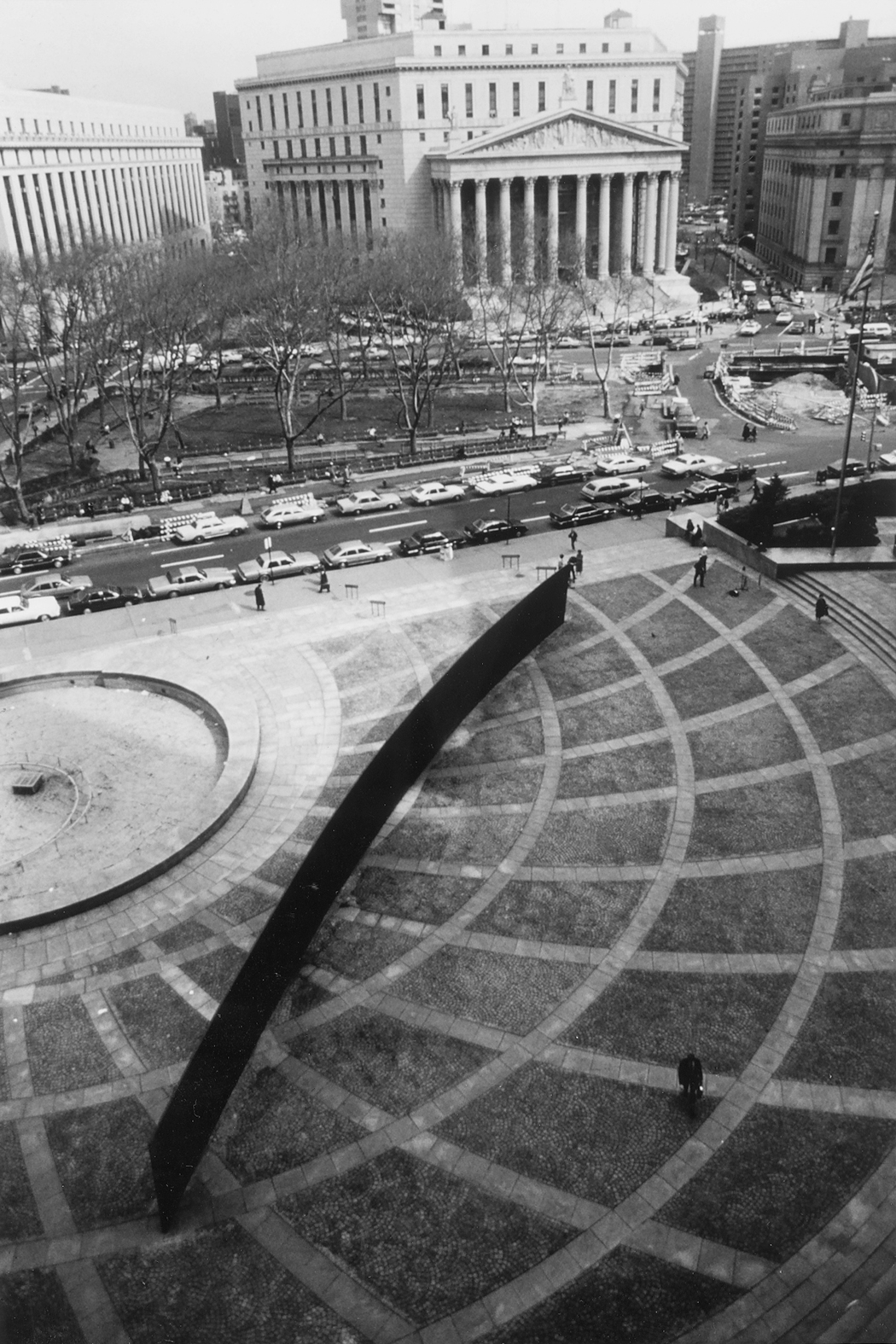
Richard Serra, Tilted Arc, 1981, aerial view
How dare this artwork physically exist in our space? Up to the moment of encountering sculpture, the museum visitor can walk around freely, looking at paintings from any distance and angle they would like. With a sculpture located in the gallery space, they must work around it to view other works. Sculpture is an obstruction and an unavoidable mass of ‘fat’ that makes viewers aware of the vast empty spaces surrounding the artwork. In fact, without the existence of the sculpture, the room’s space cannot be recognized. Without sculpture, space is not space. It is nothing, yet something at the same time. Emptiness can only be recognized with the presence of fullness. Therefore, when a sculptor creates physical masses of fat, it also creates the existence of empty spaces. Take for instance, Tony Smith’s Smoke. Walking through, you have no choice BUT to notice the hollow spaces, because each and every leg of the sculpture is an obstruction in the viewer’s space.
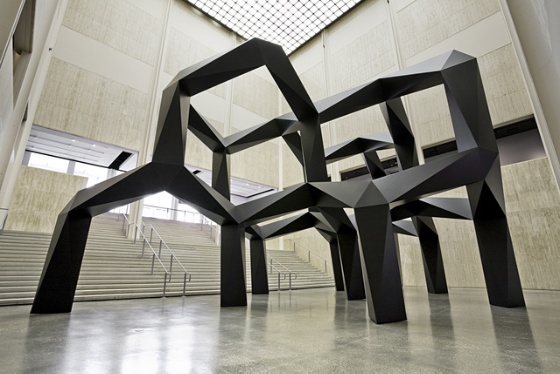
Tony Smith, Smoke, 1967
But invading space? One might wonder if my wording is a bit dramatic. In fact, I intend it to be. Rodin, a French sculptor (1840-1917), often times regarded as the predecessor of modern sculpture, challenged the barriers of traditional sculptural relationships to the audience and space. Due to the three dimensional nature of sculpture, particularly of figures, I understand that it is problematic to photograph sculptures in the round. Thus, I have here three images of Rodin’s Monument to Honore de Balzac from three different museums to give a sense of how the sculpture may look in the round.

Auguste Rodin, Monument to Honore de Balzac, first modelled 1897
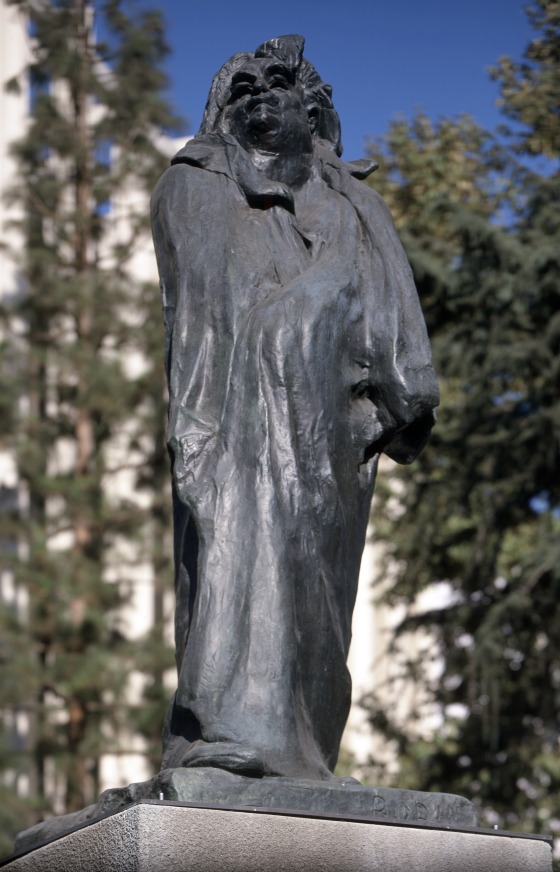
Auguste Rodin, Monument to Honore de Balzac, first modelled 1897
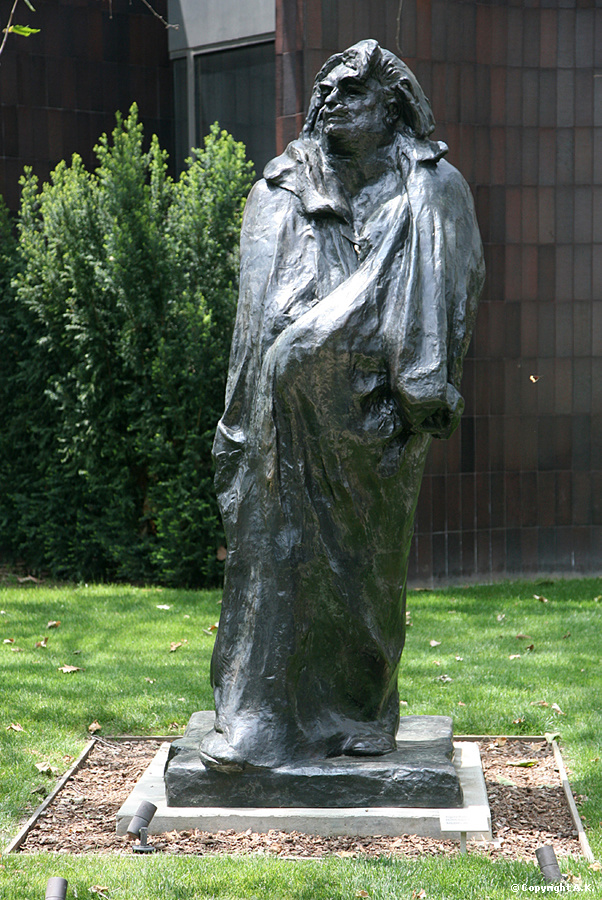
Auguste Rodin, Monument to Honore de Balzac, first modelled 1897
Paintings are restricted by their frame and canvas. Traditional sculptures are restricted by their base. Rodin [and Balzac] clearly choose to break free of this restriction. If the sculpture is viewed from the side, it is apparent that Rodin has provided ample space for Balzac’s monumental size. However, Balzac is depicted in a forward motion, with his right foot stepping out of the boundaries set by his base. Not only does the sculpture in its entirety obstruct the viewer’s space, but the figure is breaking the boundaries and challenging the limitations of sculptural figures. Rodin’s choice to extend the right foot out of the base places Balzac in a completely new realm of artwork-viewer relationships.
The role of sculpture is much more than ‘fillers’ or ‘secondary art’ in museum or public spaces. The uncanny qualities of sculpture prove time and time again how important the presence of sculpture is. It makes us aware of spaces, challenges how we view art, and may even help silence the superiority complex created when viewing painting.
 theUNTITLED
Valuable info. Lucky me I found your website by chance, and I’m surprised why
this coincidence didn’t took place in advance!
I bookmarked it.