When looking at art, what does one first look at? Subject matter, form, technique, colors? The beauty of having control of the canvas is that the artist also has control of what to emphasize in the work.
Alexander Rodchenko, a Russian avant-garde artist, was born in St. Petersburg to a working class family in 1891. As a child of a working class family, he truly believed in the Communist cause, he eventually gave up paining in favor of photography in the 1920s.
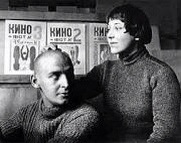
Alexander Rodchenko and his wife, 1920s
Rodchenko was one of the early figures of the Constructivist movement, alongside his wife Varvara Stepanova. The term “Constructivism” was not actually used until the October Revolution of 1917. Constructivism also had a more industrial ring to it, straying away from the compositional nature of art that they were trying to avoid. Constructivism meant to heighten spacial and constructivist elements of art in an era of technological advancements, rather than flaunting ostentatious and unnecessary details in art. Constructivism in Russia was initially started by Vladimir Tatlin in 1914, and continued by Alexander Rodchenko and his counterparts.
The 5×5=25 exhibition, which included artists Rodchenko, Varvara Stepanova, Lyubov Popova, and constructivists, introduced the new reality of art working in accordance with the Communist ideologies. Paintings were included in the exhibition, but only if they were sketches for spacial compositions or served a Constructivist purpose.

Alexander Vesnin, 5×5=25 Exhibition catalogue cover
In 1921, Rodchenko painted Pure Red Color, Pure Yellow Color, and Pure Blue Color , as his last three paintings, which were a part of the 5×5=25 exhibition. In an era filled with pure egalitarian hopes and expectations, Rodchenko believed that traditional methods of painting and sculpting were dead and bourgeois. Years later, Rodchenko recalled that the monochromatic triptych was the representation of the essence of painting in the purest state, as well as the end of painting for himself and in general.
I reduced painting to its logical conclusion and exhibited three canvases: red, blue and yellow. I affirmed: it’s all over.
Basic colors.
Every plane is a plane and there is to be no representation.
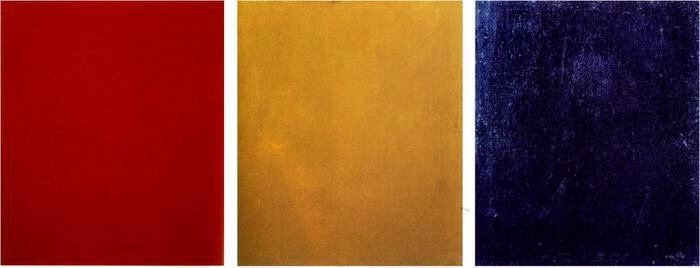
Alexander Rodchenko, Pure Red Color, Pure Blue Color, Pure Yellow Color, 1921
Painting is in essence, basic colors. Rodchenko’s triptych of the early twentieth century is a great representative piece of the end of painting in the traditional sense. The Constructivist movement is one of the final greatest movements in Russia before the emergence of Socialist Realism as the sole art form of the USSR.
Rodchenko’s triptych is a predecessor to Minimalism and monochromatic paintings. Although some similarities exist between future monochromatic paintings and Rodchenko’s triptych, the essence of Rodchenko’s “Pure” paintings is political. Even if the system was a failed experiment, artists truly believed in the cause and were completely dedicated their art to the promotion of a Communist state.
As Rodchenko said, “artists are catalysts for social change.”
 theUNTITLED